
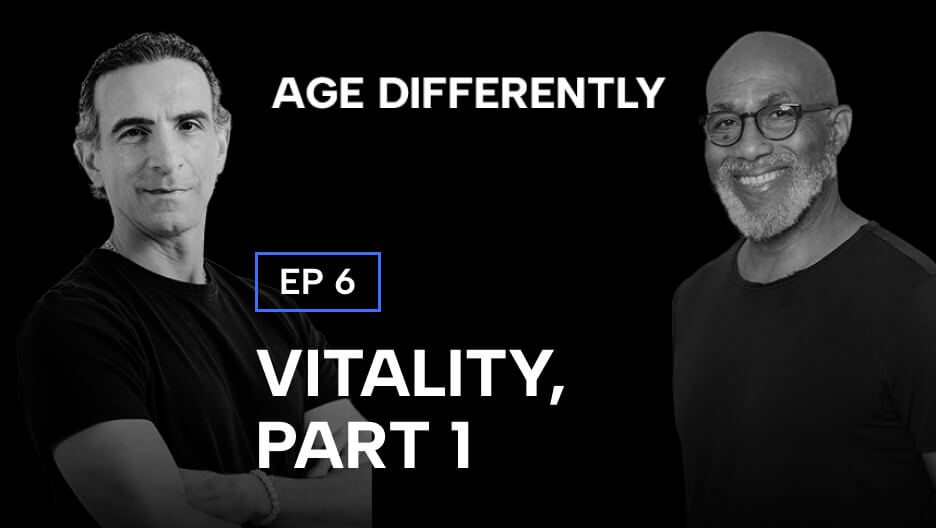
EP 6

Vitality, Part 1

Looking for the best motivational podcast for men? Look no further than this episode. In Part One of this two-part episode, Darius and Peter introduce and discuss the concept of “aging differently”. They discuss the process of aging, and the importance of integrating physical, mental, emotional and spiritual wellness to age gracefully. They explore different approaches to longevity, and examine the role of exercise, diet, and nutrition (including supplementation). The episode concludes with a focus on self-care and emphasizing the importance of making mindful daily choices.

Key Points
  • Aging with vitality involves taking a holistic approach to health (i.e., diet, exercise, and mindfulness) that recognizes the interconnectedness of the physical, mental, emotional and spiritual. 
  • Making conscious, daily choices can significantly influence the rate of aging and overall well-being–small choices made consistently over a longer period of time have tremendous benefits!
  • Ongoing experimentation and personal responsibility are crucial in discovering what works best for an individual’s unique physiology and lifestyle.
Automatically Generated
Peter
Welcome. Greetings. Good day to all. Thanks for joining us for our podcast. 50 to 70 meaningful conversations between men. I'm here joined by my co-host, Darius.
Darius
Peter, it's good to be here with you again.
Peter
Good to see you as well. And I'm delighted that we have this opportunity to talk about the topic of this episode. You wanna introduce our audience to what this episode is?
Darius
I'd be glad to. This is a topic that we've had many conversations on. Aging with vitality, not just prolonging lifespan, but prolonging vitality with how we live longer. And it seems like over the last couple of years, there's just been a ground swell of research on this topic with guys like David Sinclair and Peter Attia, and even, I think Tony Robbins put out a big book recently on this topic. So it's something that's becoming more front and center these days.
Peter
And it's important as we have a global population of boomers that are aging all at the same time. And the demographics have shifted over the years, throughout and there's such a need to talk about how we might age. Sometimes I use the word with more grace.
Darius
Can I share with everybody what happened at the gym this morning when we were working out together?
Peter
I'm not sure, but go ahead.
Darius
So as many of you know, I got to know Peter at a mindfulness class, and part of mindfulness is mindful movement and stretching. And Peter is a yoga teacher. And I had been complaining about certain parts of my body being tight, and I was in the process of stretching. And I've been stretching for 4 minutes on my hamstrings, and they were starting to move. And Peter lied down beside me.
Darius
And I looked over, and he was at least a foot deeper into the stretch that I was in, and I looked over. And I said, “So you’re showing off now.” Well, missing a beat, Peter says: “Not yet.” And then you're really stretched, but the reason I relate that story, Peter, is you're 70. You're almost 71.
Darius
I mean, you're a role model for me as to how you should age with grace. And so thank you for that role that you've played. It's incredible.
Peter
If you don't mind, I'll correct you. It's not a matter of should. I would like to share with the audience. They could. They have a choice.
Darius
They do.
Peter
And so, I've made my choice. I continue to make the choice with a certain attention and awareness that there is a choice. It's a choice, and we'll talk about this a bit today. In how and what you eat.
Darius
Mhmm.
Peter
Exercise, which you just referred to. Getting the appropriate amount of sleep. You know, the one that's often kind of overlooked is your mindset.
Darius
Agreed. So we're gonna talk about those. This episode is so long. We're gonna break it into two parts for everybody. And today, we're gonna go through movement, nutrition, and supplementation. Next week, we're gonna go through micro stressors. So healthy micro stressors, relationships, meaning, purpose, mindset, sleep, as well as a preventative approach. Yes. So I gotta ask the question. You're 71. You look like you're 35 years old looking across from me.
Peter
I'll pay you later.
Darius
Let's talk about movement. And you've made a choice: What does that entail for you at 70? How is that different from you at 50?
Peter
I will confess that at 70, there are more limits. The body is naturally in its progression of degeneration, and it's something to be really paying attention to because at 70, what I've discovered recently is you come to the cliff and you go over it. And if you're not careful, you'll keep cascading down the mountain.
Darius
What do you mean by that?
Peter
The body it doesn't degenerate in equal proportion. And then you have we each have some kind of genetic propensity as well. And then there are all the incidents and accidents, throughout life. All little chinks in the armor. Right? And so there are weak points in your physiology as well as your mental capacity.
Peter
And if you're not attending to them, if you're not caring for yourself while being in those areas, then they just keep degenerating. And you know, we can't cover all bases, but we can cover most. I try to really pay attention to the fact that I'm not just a physical body. I'm a mental aspect. I have a mental aspect to it.I have a mind. That's easy.
Peter
But also I have emotions. They affect my well-being. And then the one that's often not talked about is there's an energetic component to my existence. It's not well documented. It's not discussed a lot. We know we have, I will say this, most of us have had experiences with instincts. And intuition. That's not the mind. What is that? And then there's a science that's thousands of years old. That's being now kind of revived in our modern day.
Peter
It's called acupuncture, and it's based on energetic meridians throughout the body. I'm not saying it's true or untrue, but what if it is? So with the suspicion that there may be some truth to it, I consider it. I don't ignore it.
Peter
And so maybe I'm mind and body, I’m emotions, and I'm energy. Is there anything I could choose to do to maintain my overall health and well-being? Is there anything I do that degrades it? I like to say that aging is a natural process. But we do many things if we're not careful, if we're not paying attention, to accelerate that process. And we also have the choice of doing things to slow down. And enhance, slow down the degradation, and enhance the well-being, enhance the vitality. There are things we could do. And I would say that you and I are pretty aware of it, but I also think there's a lot of familiarity out there in our culture.
Peter
You know, exercise, for instance, getting to the gym, eating right, all of those things are common knowledge now. I want to believe. But it's the will. It's the understanding. And maybe this conversation we're having will start conversations among men that, “oh, I could perhaps do more.” I could be more proactive in my longevity, my vitality. There are glimmers of it being discussed, but maybe there needs to be more discussions about it.
Darius
Yeah. I agree. I think feeling at our culture and the stats we were saying on diabetes earlier: 30 million US residents have diabetes. 100 million are prediabetic. So while I think diet and exercise are common sense, I do not think they're commonly incorporated or become a habit or routine.
Darius
I do like what you said about aging is a combination of energy with the mind, the body, and the emotions. And I do think it's natural, but I'm more now thinking about it like a chronic disease. Something we all have, but something that if we are mindful and we make choices, we can slow the progression of that chronic disease. Just to be clear, no one's gonna win this game.
Darius
We all know how this game ends. But it's how to make the most of the experience while you're in your sixties or seventies, your eighties. So that you continue to do what you love to do.
Peter
Yes. Yes. And so you can continue to experience. I think sometimes we lose sight of that. There are a couple wonderful books out there that talk about: we do not plan or account for living and longevity. The account for aging and death, even though we really have many conversations about death, that's another episode we may want to handle at some point in time. But in terms of longevity, how many men in our audience plan for living to 90? Or a 100?
Peter
How much consideration I would ask our audience have you given to what happens after retirement, 65, 70, maybe up to 75. How about 80? Yeah. And so the invitation here is perhaps to start to formulate your life with maintaining vitality into your 80s, into your 90s. There's a book out there. “I’ve decided to live 120 years”. I think it's the title of the book, and what if that was possible? I asked myself that question. I asked myself other questions when I experienced the degradation of my body.
Peter
And interestingly, I had one of those plane conversations. You know, when you get on the plane and you're with a stranger and you have the most profound and meaningful conversation about many intimate things. It's just 2 hours.
Peter
Right? So I had one of those, and both of us, he was approaching 70. Could commiserate with one of the things that happens to men that we kind of ignore or don't pay attention to. And I've witnessed that I want you to chime in.
Peter
I believe it starts around 50, but the degradation of men's hips for instance, the mobility of running the knees, ankles a little less. The back issues that come up. So this gentleman, and I won't mention his name because I don't know if he would want me to. Both knees replaced. Problems with his left hip, I believe it was.
Peter
And you know, he's just kind of making his way doing the best that he could. And I shared with him that as late as a couple of years ago, I wanna say pre-COVID or 2019, I was starting to notice my hips, a lack of mobility. I attributed it to my yoga and that I was trying to gain more flexibility in my hips, men are notorious for having poor flexibility in their hips. But it was more than that.
Peter
It was the loss of cushion, the loss of cartilage. And I recognized, well, what could I do about this? And so I went to nutrition. I continued my yoga. I researched and explored.
Peter
What is an energetic component to this? And I'm happy to say now. I'm not back to running triathlons yet. Notice I said “yet,” but I'm back to running. And I'm delighted because, again, I felt like I was heading towards that cliff.
Peter
Where if I wasn't careful, I'd go over it and there would be no returning off of it.
Darius
I don't think it starts at 50. I think it starts at 40. The reason I say that is I had a friend a year or two older than me, and he said you're 40 now. The warranty falls off. Like, what do you mean, “the warranty falls off?” The warranty falls off the body at 40. And those little issues that you could recover from fast, you no longer do. And if I think about my experience during COVID, the world shut down, I stopped moving. I sat at my desk. I worked a lot. I was very productive at work. My hip flexors went like this. My back pain went through the roof.
Darius
And I came to the conclusion—my flexibility was non-existent—I came to the realization that movement and exercise is such a huge part of aging with vitality. And if you stop moving, you're not able to move anymore.
Peter
Yeah. Yeah. That reminds me. To share with our audience just a critically important aspect to this concept of aging. We tend to treat our body in disparate parts.Even when it comes to tending to the health of our physiology, when we go and seek counsel from the medical profession. It's in components and parts of our body. And one of the things that has not failed to impress me, and that I'm learning better to share and to be much more aware of myself:I'm neither just a heart. Nor just biceps and triceps. I'm not just lungs. I'm not just legs or neck. And not just my mind, there's an entirety of your being that exists at the same time. Mind. Body.
Peter
And when I say body, all of your physiology, emotions are part of that as well, and energy. We talked about this earlier. And so when you're tending to these things, when you're talking about aging with vitality, I hope I can impress on our audience. Don't ignore any of it. Start paying attention to it.
Peter
Now if you can't pay attention to all of it at the same time, at least be conscious of that is the entirety of your being.
Darius
Tensegrity is the principle.
Peter
Say that again.
Darius
Tensegrity. My acupuncture guy (I believe in acupuncture) if I have a problem at one part of my body, he will work on another part of the body and say it's manifesting in your elbow but the actual problem is here.
Darius
So before we move off exercise, I gotta ask you a question, which is what is your exercise regimen? What do you do on a day in week out basis to maintain your vitality?
Peter
One of the things that aligns to this philosophy of the tensegrity that you just mentioned. I call it the holistic understanding—when I say holistic, I mean, whole of your body. One of the practices that I picked up young, at 15, with the intention of just being a better athlete, and now, by the way, professional athletes hire trainers who are proficient in yoga to train them.
Peter
And I picked up a yoga book. I started doing yoga. I was trying to prevent injuries. I noticed that it helped my flexibility tremendously. That's why I can, you know, I can go a little bit deeper than that?
Darius
Well done. Little shot a long way. It's appreciated.
Peter
But, I also got into philosophy. And the study of yoga, and it's so profound in the knowledge it imparts about the mind, and that fascinated me. And that's been a study of mine. And it's helped me tremendously in terms of mindfulness and meditation and MBSR.
Peter
But to answer your question, yoga works in a holistic way. Holistic, not with the h, but with the “w h”. And I learned that over decades. And I continue to learn because there's more there. I mean, there's the breath that's used, and now we're using it very much to help as we discussed in our last episode, with stress. And then there's other aspects that you know, I'm still exploring, to be honest with you. The body is a magnificent structure. We underestimate it, and we abuse it.
Darius
True. So let's switch gears from exercise. Let's talk about diet and nutrition. A conversation, you and I've had many, many times on the standard American diet, the sad diet, that we're eating: Heavily processed, heavily modified, incredibly caloric, and the resulting consequences of that diet. I can say personally, I started to do a couple of things two years ago.
Darius
(1) I started to intermittently fast and intermittent fasting is a fancy way of saying don't eat breakfast. Right? Finish your last meal at 6 or 7 pm, and then don't eat until later in the morning. And I started to eat more organic, and fruits and vegetables. And what I noticed was I had this puffiness in my face and in my body from years of stress and travel and eating out and over the course of 4 months that puffiness evaporated.
Darius
I had digestive issues, which cleaned up immediately. It was incredible just to watch with some simple changes, the impact that it had on the body. What have you experienced?
Peter
Just years of exploring, using my body as a lab to test, and paying attention to it. And reading and studying years ago, challenges. And, again, I don't want our audience; I would like our audience not to feel judged.
Peter
You and I made decisions based on what we thought was in the best interest of our health and well-being. And so we're not judging anybody. I'm not judging anybody out there in the audience, but giving up meat, decades ago, made a difference in particular right away with the digestive system. And, you know, now the evidence goes back and forth over the need for the protein and the overall contribution it makes to health and well-being.
Peter
But my choice was to leave the red meat. And over time, over the decades, any other kind of meat for some of it ethical/morality reasons than just physiological benefits. And so I gravitated towards a diet that was easier on the digestive system and still nutritious, you know, vegetarian/vegan. I've been both at times. And for this physiology, for my body, with observing my body's reaction to it, I have found it quite beneficial. Part of the reason I suspect that I don't age as quickly is because the body is not as toxic with accumulated foods that it can't process. There's evidence that meat remains in the digestive system decades after it's been consumed. And so let's say that's true.
Peter
I don't choose to do that to me. And I I think that's been my philosophy. And I would invite anyone in the audience who cares to kinda, just maybe, try that mindset for a little bit and see what's the difference? You know, how do you feel? Do you feel healthier, or do you feel less lethargic? Do you feel more energetic? What else? What are the other changes that you're noticing?
Darius
Yeah. A couple of things popped to mind. One is the mindset that you have on experimentation, which I think is really important to try things to see what's working and to see what's not work. I personally tried to be a vegetarian, and it doesn't work for my physiology. I lose too much weight. And I realized that I don't look healthy, and I need animal protein in order to keep weight on my body.
Peter
I'm so glad you're bringing this up so that people in our audience, we're discussing: We're all different.
Darius
Yes. And you have to try and see what works for you, but You raised something that I thought was really, really important. I mean, this is clearly a judgment free zone. We don't care. This is our learnings you take from our learnings, what makes sense, and what resonates with you, and incorporate it.
Darius
What of the rest of it doesn't make any sense? I'll just ignore what we're saying. But what I've learned and what I've seen with you: There's no silver bullet when it comes to aging with vitality. There's not one thing that we can say: You go to bed at 9 o'clock every night and you sleep till 6 o'clock, you're gonna be fine. It is a series of small choices that are made almost, you know, marginal on a daily basis that cumulatively—when added together—turn into something transformative and diet, you are what you eat.
Darius
And I just go back to the simple question. Do I wanna be gonna use this one? Do I wanna be a strawberry or do I wanna be Cheetos? And the reason I'm saying strawberries is Peter doesn't like strawberries, but I happen to really enjoy them. So do I wanna be fruits and veggies? Do I wanna be organic meat or do I wanna be a Dorito or, no offense to McDonald's, I wanna be a Big Mac and whatever goes in those fries? And I don't for my body, that just doesn't work anymore.
Peter
And being aware of that, I think that's what we're sharing here. So making sure you're paying attention to how it's affecting your body.
Darius
Seeing when you eat something, how you feel, how you feel afterwards and how you feel the next day? So one last topic to cover in this one. Supplementation. And let's start off with your wonderful mud coffee. And what goes in there? I love the components that are in there. You know, I've incorporated that into my daily regimen.
Peter
Yeah. I'm not sure how much of the audience is ready for this, but let's go ahead and talk about it.
Darius
It's just I mean, Peter, so when I started working with Peter, I was struck by what he was doing, and I had to ask him, what he was doing from a supplement perspective. And Peter makes this wonderful coffee. I don't like coffee, so I've turned into a smoothie. It has a number of different mushrooms and herbs that are designed to improve vitality, cardiovascular function, anti-inflammatory. But I think as the body gets older, the reason I bring this up, in my experience, I'm already starting to see it, we need additional supplementation to account for gaps that are in the diet. I don't know if it's because we've depleted our reserves that we have.
Darius
I don't know if the body's not absorbing it as well as it used to, but the conclusion I'm reaching is I need more supplementation to help the body continue to run as smoothly as it is.
Peter
And maybe that's enough. That's all you need. The why or the understanding of what's depleted and why it's been depleted may not be as important as knowing supplementation is needed. And that's how I have chosen to give my body nutrition. I do not not understand why it feels, again, It doesn't necessarily, in terms of the lab work that I have done annually when I go from my physical, it doesn't show any depleted minerals or any depletion, but I feel like I'm not at my optimum. And then there's research out there that, I think it's, like, that 70% of the population in the United States is deficient in magnesium. How or why is that? And then each of us has different deficiencies. Another one that's come up recently. It's trending quite a bit is Vitamin D. Right?
Darius
Absolutely.
Peter
I live in Florida. Why would people in Florida be deficient in Vitamin D? They should be able to get plenty of sun. So I'm not understanding this. I don't understand the science.
Peter
So maybe the best I can do is understand my science. Yep. How I'm feeling. Pay attention to it. What's different when I take Vitamin D? What's different when I take high doses of Vitamin C? What's different when I take my favorite antiviral garlic? How does it work for me? And maybe it works as well for others, but the invitation here is: Explore. What kind of supplementation keeps your vitality, resists disease? Resists, let's say, higher gradations of, like, the flu or the cold. And pay attention. What have you done that's different? And that has enabled you to be healthier and has enabled you to maintain relative health even with the barrage of COVID.
Darius
Yeah. So I can say one of the things that I experimented with, I was Vitamin D deficient. The range is between 30-100, and I was coming in at 26-27. I was also getting a lot of colds. And so about 3 years ago, I started taking Vitamin D supplementation. My levels are now in the middle, and I started taking a cold shower every morning.
Darius
So I'll have my hot shower and then 7 minutes in the cold. I don't get sick anymore. Everyone around me will come down with a cold or a flu. And the only sign that I've been exposed is that my nose will run for a day, and I'll look around. Who close to me is ill? And then it's gone the next day.
Darius
And it's that experimentation. I've now increased Vitamin D levels. My levels are now normal. I've added the cold shower because for my physiology, it fires up the body first thing in the morning. And my immune system has been reset, but that experimentation, that checking, that challenging, that testing.
Peter
Figuring it out for yourself.
Darius
Yeah. Because I love the medical profession. Medical profession has saved my life multiple times. Only person who lives inside my body is me.
Peter
I'd like to say it often to anybody who will listen: There's no greater authority on your body than you. Somebody who spends 10 to 15 minutes with you, I don't wanna deprecate the medical profession, but they don't have a chance to get to know you.
Darius
They don't. They don't see all those micro choices that are being made.
Peter
So who does? That would be you.
Darius
So we're coming up on time. Once again, 30 minutes goes by, like, 3. And so what do you think of a potential call to action for this? Should we ask them to cut out processed food, start a supplement? What would be a good call to action based on what we've been talking about for the last 30 minutes?
Peter
Have a conversation. With yourself. One that's honest and truthful. This would be the call to action: Whether you are really caring for yourself.
Darius
And then build on that. What do you want to do? Because what we're talking about, this stuff isn't easy. It goes back to the conversation we had about hard, you get to choose your hard. Yeah. Do you wanna have it difficult now and not eat that piece of cake? Or do you wanna have it difficult later after you've eaten it and now need to absorb the consequences.
Peter
Yeah, and that's an important point that you make. Because you don't just pay for it later. You pay triple.
Darius
You do.
Peter
Or ten times. I mean, one of the best examples, the mushroom mix, the reason I was attracted to it was because, you know, we've done a little independent research. We had a study done. You and I. And there are plenty of studies out there that show that mushrooms have properties that retard cancer.
Peter
And so that's one of the biggest ailments in our modern civilization. Why not give it a shot and see if it could make a difference. Spend the money now and maybe avoid having to spend money on cancer treatments down the road.
Darius
Absolutely.
Peter
We don't know. Why not see? And so, again, it's we're talking about a mindset that we'd like to share with our audience that just looks at aging and vitality and wellness and well-being as something we, you and I, have responsibility.
Darius
So I think with that, you know, normally, we close with a poem. Today, we're gonna close with a quote from Ray Crock. Ray Crock is the founder of McDonald's and I actually had this quote over my desk when I was going to business school and it's simple, “Success is 1% inspiration, 99% perspiration.”
Darius
And when you think about what we're talking about right now, aging with vitality, 1% inspiration, it’s the 99% the decisions that you make every day, the choices that you make to go for a walk after dinner, to call a male friend and have a conversation. Versus picking up your phone and just doing this for 2 hours and numbing out. It’s am I going to eat, make a salad or am I gonna go and have Arby's or McDonald's? It's all those little choices. That's what I mean. It's the 99% perspiration.
Peter
Yeah. Yeah. Important to highlight. We're too much of a culture and society that just leans on convenience.
Darius
Wonderful. So that wraps up part one. In two, we're gonna continue this and look at other things that we've come to learn. Peter, another delightful conversation.
Peter
My joy. Thank you, sir.
Darius
We'll see everybody in part two.

Disclaimer

The “Age Differently” website and associated podcast (the “Podcast”) is intended for educational, entertainment, and informational purposes only. The Podcast is not intended to provide medical advice, diagnosis, or treatment of any health problem or disease. There is no doctor-patient relationship between you and anyone appearing on the Podcast. Always consult with your doctor or other qualified healthcare provider regarding any and all medical decisions. Do not disregard any medical advice or delay consulting with a health professional because of anything you hear on the Podcast. If you think you may have a medical emergency, call 911 or go to the nearest emergency room immediately. Any claims about possible health benefits conferred by any foods, supplements, or activities discussed on the Podcast have not necessarily been evaluated by Food & Drug Administration or any other institution or regulatory body. The ideas and opinions expressed on the Podcast are personal to the individuals expressing them, and do not represent the perspective of any other person or institution. The Podcast is provided on an “as is” basis and with all faults. Neither the company nor its employees, nor any contributor to this website or podcast, makes any representations, express or implied, with respect to the information provided herein or to its use. Any reliance on information discussed on the Podcast is entirely at your own risk, and no one who appears on the Podcast shall be liable for any resulting losses or damages.

Read More
image

Our Newsletter

Reflections, reminders, new episodes, and tangible applications delivered to you.

Loading