
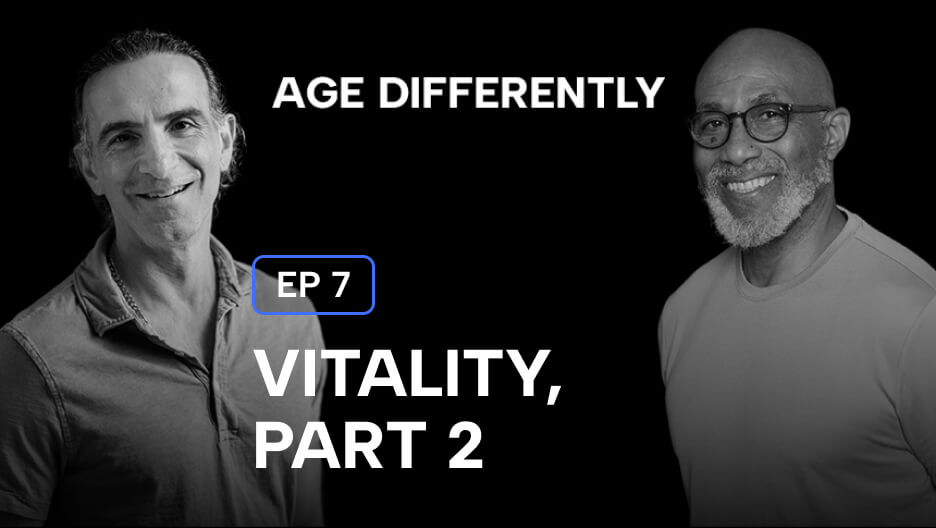
EP 7

Vitality, Part 2

In the second part of this two-part episode of our inspirational podcast for men, Peter and Darius continue the conversation on “aging differently”. They explore aging with vitality, discuss the role of healthy micro stressors, relationships, and self-care. They delve into the importance of meaning and purpose in life, individual sleep needs, and conclude by recommending a preventative health mindset.

Key Points
  • Engaging in micro stressors like infrared saunas and cold plunges can potentially create “ledges” that slow aging by helping the body adapt and recover, as well as decrease risks for diseases like Alzheimer’s and cancer.
  • Nurturing meaningful relationships is foundational to joy and happiness; being present and accountable strengthens these connections and contributes to personal growth.
  • Choose to prioritize your health now, or make time for the suffering that will inevitably follow: it’s your choice. 
Automatically Generated
Peter
Welcome, good day and, hello to our audience out there. Welcome to another episode of the 50 to 70, Meaningful Conversations Between Men podcast. I'm here with my good friend, Darius. Hi, Darius.
Darius
Good morning, Peter. How are you?
Darius
I'm doing quite well today. We're gonna talk about some interesting stuff today.
Peter
What kind of interesting stuff?
Darius
Well, in the first part of this episode we talked about aging with vitality and we focused on exercise, diet and smart supplementation. Today, we're gonna continue that conversation, but we're gonna focus on other things that have been shown to potentially have a benefit in increasing the vitality as we age. Those include micro stressors, relationships, sleep, finding meaning, purpose and a mindset of preventative health.
Peter
All of them, elements, tools, of a philosophy that we have.
Darius
Correct.
Peter
About aging. Right?
Darius
Correct.
Peter
And we had a conversation yesterday, in the episode prior, where we talked about learning to manage walking the edge of the cliff.
Darius
Yeah.
Peter
That's your age.
Darius
Yeah.
Peter
Remember that?
Darius
I do. I think it might be helpful for us to kinda kick off this episode by summarizing that conversation because it was a delightful conversation afterwards that we had ruined a little deeper into that construct.
Peter
Yeah, we did. The experience I've had, that I shared with Darius, is that a lot of my experiences now at 70, and it actually started probably at 60 and Darius reminded me it probably started when I was fifty, the body starts to age, degenerate and it's a process that starts almost from birth. But yet, it balances out over time. You have accidents, experiences, and the body restores, renews, rejuvenates. That's the natural process but then that process begins to slow down as we age. The body begins to degenerate.
Peter
And what I've discovered is that it's something like walking on the edge of a cliff. Sometimes you'll slip and the older you are, the less quick you are, to grasp the ledge and keep from maybe sliding further down over the edge of the cliff and so there are things that we can do that I've done, and you came up with just a wonderful way of illustrating it through some of these, elements that we're about to discuss, microstressors.
Peter
We've talked about them in our last episode as well. Exercise, supplementation, diet. Those are ways when you age to create ledges. So when you fall or you slip over the cliff, you have a ledge that you can grab onto. You can hold onto it so you don't continue the slippery slope down.
Darius
That's right.
Peter
You experienced any of that at 50?
Darius
Like I told you yesterday, the warranty falls off the body, I think at 40, that's why it gets even more challenging and it's all those small decisions that we're making that are either creating those ledges for us to have a softer landing and an easier recovery.
Darius
Or are slowly sandpapering them, blasting them away so that there's nothing to grab onto and we're, inadvertently, not meaning to most likely, creating a situation where it is more challenging for us to come back when we do slip. Because it's not about if we're gonna slip, let's be honest. Everyone is gonna slip. We could wrap ourselves up in bubble wrap and not move, and we're still gonna slip. It's how quickly we recover that shows how healthy we truly are.
Peter
And I'm recalling in that last episode, this came up because we were talking about aging as being a process of degeneration that is unavoidable. But in our modern culture, with the way we eat, with the lack of mindful movement, lack of movement, exercise, lack of sleep—what we're doing is accelerating the process.
Darius
Yeah, we're getting we're not making ledges, we're removing ledges.
Peter
That's right.
Darius
So let's talk about a way that we can make a ledge.
Peter
Please.
Darius
A healthy micro stressor that you hadn't experienced in a while, but you got to experience last night. The infrared sauna, tell us about it. How was it?
Peter
I still think this is crazy. I had the opportunity to sit in Darius’s sauna and it's not your typical hot sauna or when I say hot, moist wet sauna or dry sauna, it's an infrared sauna. And it has the benefit of instead of, from the external, I'm gonna do my best to explain this from my experience, instead of warming up from the outside in, you warm up from the inside out. Phenomenal experience and afterwards, after sitting for 25 minutes, all I could bear, set out in the cold. What was it, about 30 degrees?
Darius
32 degrees, 31 degrees…
Peter
Didn't feel a thing. It did feel wonderful. It really did. And the effects of that, the kind of quiet in my joints, that's the best way to describe it. My joints didn't feel afflicted, they didn't feel activated, they felt calm. Sometimes the way I feel when I've done a nice meditation and I've just been still for a while or a great yoga class. So just another way, another ledge.
Darius
Yeah, and the science behind it is really astounding. There's something called heat shock proteins. Proteins that are released when you're exposed to heat and those proteins go by and they clean up toxins in the body.
Darius
If there's misaligned proteins or proteins that aren't correctly formed, they'll clean them up and the studies that have been done on saunas, particularly in Finnish people, which is where I learned it from, have shown significantly, I think, two thirds decrease risk of Alzheimer's, decreased risk of cancer. The article you sent me on the infrared sauna saying they're actually using infrared saunas to treat cancer right now which is mind blowing.
Darius
But it's a healthy stress that requires the body to adjust and adapt. You're right, when you're done, you feel great because you have just flushed the system of all the toxins that you've dealt with over a day, a week, a month, who knows how long.
Peter
So what does that have to do with longevity?
Darius
: That creates a ledge for us because if you're taking care of yourself and you're feeling that quieting in the joints, when you slip, the slip might not be as far, you've got that ledge that you can go back to and build back up from. And I would actually even go further and say if you use this as part of your recovery regimen, it will help you restore after you've done a heavy exercise.
Peter
Yes. Yeah. Aren't athletes starting to use this more, didn't you tell me something about a team that is now making it part of their recovery therapy?
Darius
Yeah. That's hyperbaric oxygen which is another micro stressor that's also been shown where you get in a tube and the pressure is taken up. I don't know how high it goes and then it's pumped full of refined oxygen and the theory behind hyperbaric oxygen is really simple.
Darius
It allows oxygen to get to parts of the body more easily than it otherwise could. So I've been experimenting with this for the last few months and I was feeling great. Then I stopped because I was busy and traveling and within two weeks, I noticed the immediate effects in my joints and it was, okay, this for my body, is absolutely helping with joint function and decrease the inflammation and the pain.
Darius
And it was a clear sign, you know, going back to treating us like a lab and listening to the body. My body was telling me cleanly, if you do this a couple times a week, your joints aren't gonna hurt as much. It's your choice to make right now and that's another example of a ledge that we can make.
Peter
Yes, and believe me, at 70, maybe it's 60, your joints start to talk to you, my talk to me all the time.
Darius
So I'm really curious, because there's another micro stressor that we're gonna be trying this evening, and when I tell people that we do this, most people look at me like I'm a little insane. Which is not only will we do the sauna, we're gonna go jump in, and for those listening, the temperature in Boston today is about 32 degrees, first snow of the year, Peter and I are gonna fill a bucket full of water and ice and he and I are gonna go jump in the cold plunge. It’s the same thinking: You've now flushed the system out and then when you get in the cold plunge, it causes the blood vessels to constrict. What did the producer who just came here say it was? The essence of life? The meaning of life, the purpose of life?
Peter
The meaning of life.
Darius
It was the meaning of life. So we're gonna have to experience that in a few hours.
Peter
Yeah, the craziness. Alright, no, we're not crazy, but we are continuing a philosophy and approach where if something works to decelerate the aging and accelerate the vitality of our lives to bring it up to a high level, is why not give it a shot. You know? Try it.
Darius
Try it.
Peter
Don't just deny yourself the opportunity of seeing if it benefits you. And, so I'm not crazy about the idea, but I'm gonna give it a shot.
Darius
Choose your hard Peter.
Peter
Choose your hard. And, yeah, exactly. Choose your hard and in choosing this hard, if it gives me better mobility, faster recovery, which, you know, that's the science, then why not give it a shot?
Darius
So let's talk about something different, different theme here that has been shown to have major implications on longevity and vitality, and that's relationships. The relationships you have, not only with your male friends, you guys have already hopefully listened to that episode, but with your parents, with your children, with your family members, with your community, with your friends. You know, at 70, I'd love your thoughts on the impact those relationships have had on you, during the last 20 years of your life.
Peter
Relationships are the foundation of joy and happiness. They're so difficult to manage because we each come with our own life experiences, our own traumas, our own imprints in our psyche from what we've experienced when we were younger before having these relationships, in particular before we meet our partners or our spouses.
Peter
And we have them when we have our children. And whether we're conscious of it or not, whether it's children, spouses, partners, we come with these imprints in our psyche that unconsciously provoke us. And there's a term I use sometimes, these experiences are sometimes “painful” and what we do, if we're not conscious, we're not paying attention, is we regurgitate the pain from the past.
Darius
Yep. We recreate it.
Peter
And it comes up in relationships and it gets in the way of relationships, and what I've learned is to try to be much more conscious of it. I am so imperfect at this. It's such a work in progress. There's so many things I wish I did differently, but it doesn't help me to wish and fret and regret and what if. It's done with.
Peter
And so, what I'm learning, and I and I want the audience to hear that, what I'm learning, I haven't learned it yet, is to be more present in relationships and not to bring the baggage from yesterday and know the difference when I'm doing that. And we talked about this in the episode on stress. One of the ways, one of the indicators, is to know how you're feeling emotionally.
Peter
It's a great indicator. The thoughts are there, and that's probably a good indicator, but you'll run away with your thoughts. You'll wander off.
Darius
I'll tell you one of the most powerful things I've learned. Two words: “I'm sorry.”
Peter
Yes.
Darius
No “I’m sorry, but,” or “I’m sorry, but this is why,” no. No, it's just you know what, I realize I've done something that I regret. I see that my actions or my words have caused you distress. I'm sorry and I'm gonna take that and I'm gonna try and learn, and I'm gonna try and do better.
Peter
How do you avoid feeling the vulnerability that maybe in the past has gotten in your way of saying, “I'm sorry?”
Darius
I don't think you can, because that's another thing. To say you're sorry, you have to be open.
Peter
Yes.
Darius
And you have to accept that by opening up you're showing that you are invested in the relationship and the more I've come to think about it, there's a real power and vulnerability because you're being true to yourself and you're not doing the thing where you walk away and you feel self-righteous.
Darius
That's one of my wonderful crutches, I walk away when I've been quote unquote “wronged,” usually wronged in my mind as a result of some belief that I have, and then I stew about it.
Peter
So you said something interesting. Not to put the stewing aside, but you said be true to yourself. What do you mean by that?
Darius
I think everyone has an authentic self and for a lot of reasons, people hide who they are. They're afraid of being judged and found lacking, they're afraid of being unworthy. But when you realize you have done something that you regret and you're able to honestly say, “I'm sorry,” that’s being true to who you are.
Peter
Is that a form of care? And is it a form of self-care, not just care for the person in the relationship, but have you ever looked at it that way?
Darius
Absolutely, I think it's care of the relationship.
Peter
Yes.
Darius
Right? Because you are recognizing it could be a good friend of yours. So I had a good friend, and I hadn't seen him in 30 years. He came out to visit and it felt like we had seen each other two weeks ago and we're sitting down, I have a beach place down on the shore. We're sitting on the wall, I looked at him and I said, “Alright. I need to apologize to you.”
Darius
And he looked at me, like, “Why?” I said, “Do you remember this night 33 years ago?” He's like,” Of course, I remember that night.” “I did that because I wanted to hurt you. I am really sorry.”
Darius
And he looked at me and he goes, “Why are you apologizing? You know why you did what you did because I had done something two years earlier. I'm the one who should be sorry.” We had this almost teary eyed moment and it was just “I'm sorry, I'm sorry.” Everything was forgiven. So it's care in the relationship, it’s care of yourself and it's care of the other person.
Peter
Yes.
Darius
And I think going back to a point you're about to raise, there's certain relationships that earn that level of trust, and earn that level of care and consideration. Your family, your close friends. And then there's other people that might be in your life, but aren't going to be in there because those relationships are more superficial. And that's where you need to make the decision: Am I going to invest in this relationship? Or am I going to take my time and invest it somewhere else?
Peter
Yes. Time.
Darius
The only commodity we have.
Peter
That's right.
Darius
Alright. Let's switch gears, speaking of time. This is a big one and I'm really looking forward to when we do a full episode on this one, but meaning and purpose. I can tell you when I started to get interested in meaning and purpose, it was the start of COVID, my brother-in-law got really sick. He was diagnosed with late stage stomach cancer and he passed away 4 months later.
Darius
So I'm sitting on a beach with my kids on vacation, miserable, grieving for his loss.
Darius
He was far too young and I picked up Victor Frankl's book “Man’s Search for Meaning.” Just a powerful, powerfully stunning book.
Peter
What was powerful about it for you?
Darius
His story. How he survived going through what he went through. He was a Holocaust survivor and how he managed to create good from that experience and I think he lived to be something like 93, and that's when I started thinking about purpose.
Darius
And what I've come to learn in my experience, and I'd love your thoughts on this, when I'm in alignment with my purpose, when I am acting, behaving, doing actions that contribute to and advance that purpose, there is a flow. When I am not in alignment with that purpose, when I am distracted or doing actions that don't contribute to it, there is a dissonance that I feel physically, mentally, and I would say even emotionally as well.
Peter
Yes. Does this purpose that you're talking about, does it have to be a global purpose, save the world type of thing or can it be something else?
Darius
I'm not an expert in life missions or purposes, but my knee jerk reaction to that question is really simple: If it's true to you, it doesn't have to be global or noble or ambitious. And some of the ones that I've had experience with, or other people have shared with me what they're doing, it's those, quote unquote, small ones that are done flawlessly, where people truly apply themselves to it. That have impacts far beyond what they could have possibly imagined.
Peter
And what would you say is your purpose these days?
Darius
Simple, and it's challenging, all at the same time. Do good. And that means do good for myself, my self-care, it means do good for my family. It means do good for the community.
Darius
And with this podcast, hopefully, there's somebody out there listening that neither of us have ever met before who is listening to this and is picking up two or three things that they're gonna apply in their daily life. And, hopefully, it creates one situation they had which could have turned stressful or negative and they've got a new tool in their tool chest that they've been able to successfully employ.
Peter
So the audience is clear, we should be clear with the audience, this purpose, it doesn’t have to be noble or really altruistic, it can be as much as just taking care of yourself. Right?
Darius
It's a wonderful purpose. What's your purpose these days?
Peter
These days, it's pretty simple. It's making a difference. And it's enough if I make the difference in one person's life and it's enough that I've made a difference already in people's lives, in my family's lives, in the lives of relationships I've had.
Darius
In my life, thank you.
Peter
But continuing that, continuing by being present with purpose and the purpose that I've designed for myself, and it's a little bit different than the conditioning that I learned was what purpose should entail.
Darius
What is that conditioning? What is that belief system that you got? Cause I could tell you what the 1970s, 1980s child conditioning belief purposes make a lot of money.
Peter
Yeah.
Darius
Get married, have 2 kids, retire at 65, play golf.
Peter
Yeah. Yeah. And, it didn't feel authentic to my persona. No judgment for anybody who has pursued that path and still found their purpose.
Peter
It's not something that I personally could get passionate about and we haven't mentioned this, but for me, purpose needs some passion.
Darius
Oh, it absolutely does.
Peter
Simply retiring and then just kind of living…
Darius
Existing.
Peter
Thank you. Existing, from my perspective, didn't serve purpose and I couldn't get passionate about it. Someone out there in the audience, 65, 66, retired, playing golf every day, if you're passionate about it, and you feel like it's purposeful in terms of bringing you pleasure, joy, in your life and that's what you seek, that's perfectly fine. We're not here to judge anyone.
Darius
Absolutely not.
Peter
We're offering another way perhaps of perceiving and experiencing life other than maybe the way we've been told.
Darius
Alright, so let's switch gears. You and I don't have many disagreements, but over the last couple days, spending time together, which has been fantastic, one of the biggest differences that I've noticed between us, is when it comes to sleep and how we approach sleep. And Peter correctly pointed out that, “Darius, you're like a bear in the winter. You'd go to sleep at 9:30 or 10, you don't get out of bed until 7 am.” And it's true and honestly, if you said you wanna take a nap this afternoon, I'd say, “Peter, I could probably take a nap for an hour.”
Darius
Because I've come to learn from my body, in the winter, I need those 9 hours. In the summer, when the sun's up lighter, I can cut it down 7, 7.5, and I'm fine. But sleep is just so important and listening to the body with respect to what you need because what my needs are, are fundamentally different than your needs and it's been wonderful to watch your patterns and how vital you are and how energized you are with a sleep regimen that would devastate me.
Peter
Yeah. The science is irrefutable about the importance of sleep. But just like any prescription, it's not absolute. We're all different, we're also unique and this is one of the things I've learned in the years that I've been on this planet and the years I've been a teacher of mindfulness, meditation, and coaching.
Peter
Is that each one of us is unique and, let me add this Darius, we're special. Every one of us is special.
Darius
Absolutely.
Peter
And so if we can tap into our inner capacity of that specialty that we are, the skills that are natural to us, I feel that brings us more joy and is more authentic to who we are, as opposed to trying to be something we're not. Getting back to the prescriptive nature of medicine and the prescriptive nature of sleep, as science is kind of sharing with us, it's not absolute because the science is based on a generality. It's not based on the specific individual. You and me.
Peter
And so going back to our first podcast, going back to conversations we've had on earlier podcasts, use your own mind and body and emotions and energy to gauge what works for you…
Darius
And listen. I see you're wearing the Oura ring as well.
Peter
Yes.
Darius
To help here and make sure we're correctly interpreting what the body is saying.
Peter
Just gives information. Exactly. And then you have to decide how it works for you and you're present with your body, so you can gauge patterns and you can gauge when there's variances and what is and isn't working, if you develop the capacity to pay attention.
Darius
That's exactly right. So I did an experiment about a month ago, I decided to buy a weighted blanket. Have you ever heard of these things?
Peter
No.
Darius
See that, for those of you actually watching this, you see that? Look, what is that, oh, where is he going with this one? So I bought a weighted blanket and it weighs 20 pounds and goes on top of you. And, Peter, I will tell you that that thing is, like, sleeping in a cave with somebody cuddling you because when you roll over, you've got the weight pressing on you and it just soothes that sympathetic nervous system. Right back to sleep, you go. So anybody who's having trouble sleeping, you know, figure out what works, a weighted blanket, a consistent bedtime, utter darkness, a white noise, whatever it is, sleeping cool or sleeping hotter, you gotta experiment to find out how to get that sleep that your body needs.
Peter
Yeah. Figure out what works for you. And one way to do this is by observing and being real clear and focused on what does not work for you.
Darius
Yeah. And that kinda goes into the next topic, which is the mindset we've talked about. The preventative health mindset. How would you define a preventative health mindset?
Peter
It's been my lifestyle, my adaptation from early on. Something made me realize that rather than just submit to the vagaries of incidents and the degeneration of the body, as an example, that there might be some things that I could do to delay the acceleration. And there's been plenty of discussions throughout history about preventative approaches to disease, ailments, to colds and flu. And for me, basically, I've come to think that it's as simple as whatever you discern, you figure out, works for you. Works for you in a simple way to enhance, we were talking about this earlier today to enhance your immune system.
Peter
We do so much to deplete the immune system, and the body, with the foods, the lack of mobility, all the sleep, lack of sleep. And so if you were to, again, looking at what you're not doing, if you were to do things to enhance the immune system, to keep the immune system capable of battling off the millions of viruses and bacteria that inhabit, that you're a host to, and the immune system figures out how to balance it. Until and unless we depreciate it, we do things that are toxic to it.
Peter
We don't do things that are enhancing the immune system. So those are the things I've been doing throughout my life, trying to figure out how do I keep my immune system strong and how do I do with food and supplementation and exercise, and preventative efforts to keep myself healthy.
Darius
Well that sounds like a call to action if I've ever heard it, which is to take one of these things that we've been talking about: sleep, diet, exercise, wellness, purpose and play with it for the next four to six weeks. Experiment, see what works, see what doesn't work, and listen to what your body is saying and the feedback that it is providing.
Peter
Yes.That leads me to the perfect quote to end this episode.
Darius
Oh please, Peter.
Peter
“He began to see that the key to liberation, to freedom, to awareness, it lay with each step. Each breath, each pebble along the pathway.” And so, to the audience, I say: It's one step at a time. You don't have to reach the horizon right away. The efforts you might take today will pay off gradually eventually. And that's how we'll end today.
Darius
Wonderful, Peter. Thank you.
Peter
Thank you. Good to see you as always, and glad to have the audience participate with us.
Darius
So this will be posted on agedifferently.com. Any feedback and comments, please let us know. If not, looking forward to the next one.
Peter
Take care, everyone.

Disclaimer

The “Age Differently” website and associated podcast (the “Podcast”) is intended for educational, entertainment, and informational purposes only. The Podcast is not intended to provide medical advice, diagnosis, or treatment of any health problem or disease. There is no doctor-patient relationship between you and anyone appearing on the Podcast. Always consult with your doctor or other qualified healthcare provider regarding any and all medical decisions. Do not disregard any medical advice or delay consulting with a health professional because of anything you hear on the Podcast. If you think you may have a medical emergency, call 911 or go to the nearest emergency room immediately. Any claims about possible health benefits conferred by any foods, supplements, or activities discussed on the Podcast have not necessarily been evaluated by Food & Drug Administration or any other institution or regulatory body. The ideas and opinions expressed on the Podcast are personal to the individuals expressing them, and do not represent the perspective of any other person or institution. The Podcast is provided on an “as is” basis and with all faults. Neither the company nor its employees, nor any contributor to this website or podcast, makes any representations, express or implied, with respect to the information provided herein or to its use. Any reliance on information discussed on the Podcast is entirely at your own risk, and no one who appears on the Podcast shall be liable for any resulting losses or damages.

Read More
image

Our Newsletter

Reflections, reminders, new episodes, and tangible applications delivered to you.

Loading