
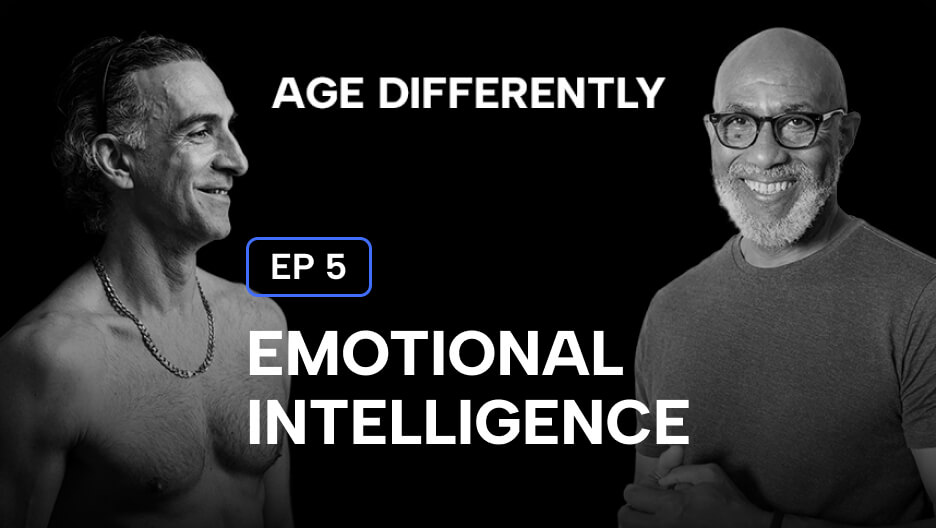
EP 5

Emotional Intelligence

In this episode of our men’s wellness podcast, Peter and Darius investigate the profound impact of emotions, emphasizing the significance of emotional literacy in maintaining relationships. They delve into fear, control, love’s duality, and the role of energy in interpersonal dynamics. The episode concludes with an insightful discussion on emotional intelligence in decision-making.

Key Points
  • Men are often culturally conditioned to suppress their emotions, which can lead to both emotional and physical health issues.
  • Understanding and expressing emotions can lead to more fulfilling relationships and personal growth.
  • Energetic acuity, the awareness of energy within and between individuals, may influence personal interactions and has the potential to be a profound skill for emotional and relational development.
Automatically Generated
Peter
Welcome. Good day. Hope all in the audience who are listening are having a good day today. Welcome to the 50 to 70 Meaningful Conversations Between Men podcast. My name is Peter, and I'm here with my co host, Darius.
Peter
Darius, how are you doing today?
Darius
I'm doing wonderful, Peter, and yourself?
Peter
Doing great. Glad to be here.
Darius
Really looking forward to the topic we're gonna be covering today.
Peter
I am with trepidation…
Darius
Oh, explain why are you reluctant or hesitant on this one?
Peter
Well, because we're gonna be touching on a topic that I think men do well with. And, you know, I have more years of not doing well with it than you do.
Darius
I don't know about that because for many years, I did absolutely awfully, by choice, on this topic, but I think this is a topic that men are not comfortable with. They avoid, they have been culturally trained to ignore and to transfer from one state to another and for those of you that haven't figured out what we're talking about, it's something really simple. It's your feelings.
Darius
Yes. It's emotions. It's as simple as that and the fact that men have emotions and they have the same gamut of emotions that women do and we, in a human body, are going to feel.
Peter
Yes, we are. We do naturally. What do you mean we've been trained to not notice our emotions? You said something very profound in that.
Darius
Yeah, it must have been somebody else that was saying that. If I think back to how men are raised, when you're playing a sport, you don't cry. If it hurts, you quote unquote, “tough it out” and you “suck it up.”
Darius
Right? If you're afraid, you don't show fear. You translate that fear into anger, into aggression, into hostility. And if you think about that quintessential male role, at least growing up in the seventies and eighties, he was independent. He was strong, he was confident. He could always figure something out. You know, you look at Harrison Ford and Raiders of the Lost Ark. You look at Rambo, you look at any Schwarzenegger movie, these guys were never afraid. They stared down death multiple times and they always came through just fine.
Peter
Yeah.
Darius
And so that's how the culture treats young men and even men of all ages expecting them to be like that.
Peter
So that's the instance of fear that you're talking about?
Darius
Sadness.
Peter
How about anger?
Darius
I would say anger is more culturally acceptable coming out of a man than many other emotions.
Peter
How about when they're a boy or a child? Is anger really that acceptable?
Darius
Well, I guess you have to look at is anger acceptable and it's an emotion and it is a healthy emotion in my mind.
Peter
It is.
Darius
Anger means that a boundary has been crossed and you need to defend yourself. How you choose to express your anger is not always healthy.
Peter
No. No, it's not. My experience with anger is one from the perspective of a child. And, witnessing anger, but not being allowed to express anger.
Darius
I think that's a pretty common experience.
Peter
Yeah.
Darius
Yeah. Not being allowed to have those feelings of anger and being on the receiving end of those feelings, I think.
Darius
I agree. If I think about emotion and we're talking about emotional intelligence, For many years, Peter, I made a simple decision: I just chose not to feel.
Peter
And why did you do that?
Darius
Because feeling is hard.
Peter
And why is that hard? I don't understand. I mean, it's just naturally, it's there. It's evident. So why is it expressed? What happens to it?
Darius
Oh, there's a whole bunch of questions here to break apart. One, why did you choose not to feel? It's hard. What does that mean?
Darius
Emotions can be unpleasant sensations to deal with. Think about grief. Grief in my mind is one of the toughest, most profound emotions that anyone's gonna experience and, unfortunately, if you love, you are going to experience grief. It's the flip side.
Peter
Yes.
Darius
It's the passing. It's permanent. Feeling grief is very, very challenging. Feeling deep sadness, very challenging.
Darius
I don't think there are negative and positive emotions, there just are. But if you haven't gotten comfortable with your feelings, feeling them can be overwhelming.
Peter
But you're stating maybe something that's obvious, if you're not comfortable with your feelings. Are we taught to be uncomfortable with our feelings?
Darius
I would say yes. A good chunk of the society as men is taught that their feelings are not appropriate. They need to be shut off.
Peter
Yes, that's why I asked. It's the impression I get that, when it comes to emotions for men, we're trained and conditioned. There are beliefs that we should just, like you said, the term you use, suck it up, that we should just repress them.
Peter
In most environments, you mentioned sports. Obviously, in the military and war, there's no room for it and there's a lot of training that flows from the military into our civilian life and in particular, in the corporate environment.
Peter
We'll talk a little bit about men and feelings and emotions in the corporate environment conduct themselves.
Darius
It's very similar to the military environment, at least in my experience. The man showed emotion, quote unquote “weak” emotions. He or she, he, was looked down on, he or she was perceived as being ineffective, not being authentic, not being able to put in a position of leadership. And in many organizations eventually exited.
Peter
But isn't that how organizations institutions, maintain their viability, and have their success by keeping this kind of uniform.
Darius
Emotionality? Oh, that's it. Oh, that's a wonderful question. And if I think back to business philosophy of the eighties, IBM. Everybody wore the same color suit.
Darius
Probably. If I think back to what I've seen in the organizations that I've created, it's the exact opposite. I want people to be comfortable expressing what is really going on. I want them to share and I think a lot of leaders now want people to share.
Peter
Why?
Darius
So that they can help the organization grow so that people are comfortable coming to them with real problems and not doing the alternative, which is saying, wow, This place is a bit of a disaster. Nobody hears me. Nobody values me. Nobody cares about me. So I'm gonna go somewhere, elsewhere.
Peter
Does it have anything to do with focus and clarity? And here's the big word. Creativity.
Darius
Does emotions have anything to do with creativity?
Peter
Your leadership style, your preferred way of leading within the corporate environment.
Darius
I don't know how I would answer that. I think my leadership style is summarized as a servant leader. I work for all those people that are in my organization, and it's my job to help them excel.
Peter
Okay. And excelling, and that's where I was directing my question. How does that style help the people that you're managing excel?
Darius
It's a biased answer because I'm the one who was obviously passionate about it. I think it helps them feel comfortable to share their truth, to share their feelings, to be vulnerable, to connect in a more authentic way. And then to perform at a different level, knowing that if they go out, I'll always tell people, “If you make a mistake, I'm not gonna be mad at you. I'm gonna ask you why you made the decision you made and what you learned.”
Darius
If you make the same mistake twice we’re having a different conversation, but you wanna create that environment where people are confident to go and take that risk and not worry that if they take the risk and it fails, I've lived in that environment, you're gonna get crucified for it.
Peter
But I still come back to: that seems to have worked for organizations in the past. Why can't it continue to work today?
Darius
Has it worked for organizations in the past?
Peter
Well, that's the debate we're having. And I'd love to hear your opinions on whether it had ever worked for organizations in the past.
Darius
It's tough for me to comment on because I wasn't at many of those organizations where it purportedly worked. I have been at organizations where it was espoused, and the definition of work needs to be quite lenient. If attrition of 25% to 30% is working, if people hating the job they're doing, but feel like they're forced to stay for financial or other reasons. Yeah. I guess it could work.
Darius
But is there a better way? Absolutely.
Peter
So this emotional literacy. We've been spending a bit on the corporate environment. Is there any other area where men perhaps don't have real good focus and clarity. Maybe the “r” word: relationships.
Darius
I would change your question around, Peter. I would ask me the question: Is there an area where men do have good emotional intelligence and awareness? And I would say across the board, in my experience, most men are challenged with their feelings based on the culture we live in, the beliefs that they have internalized along the way, and their perceptions of what a man should be. I have blind spots upon blind spots upon blind spots.
Darius
And every time I pull off one of the blind spots, I have this brief moment of “huh. Isn't that nice?” And then inevitably, I see the next blind spot that I need to start working on. Relationships, absolutely. My biggest blind spot is my relationship with my significant other, Wendy. Blind spots on blind spots that I'm working on.
Darius
Parents, kids, friends, coworkers. I mean, it's all about feeling and allowing those feelings to be and getting comfortable with them and doing something that's really simple that…I can barely say this. I actually had to get a book that defined what all the emotions are. So that I could actually start to when I was feeling something, put the right name to what it was I was feeling.
Peter
And before that book, let me guess. What were the words? I won't guess. I'll let you say. What were the words you used to describe what you were feeling?
Darius
Oh, pissed off.
Peter
Did you use frustrated or disappointed?
Darius
No. I learned frustrated again. We've talked about this; frustration not an emotion. It's where your state of being is blocked. Your outcome is being blocked.
Darius
I was pissed off. I was blue. I was tired. That was it. Okay.
Darius
There wasn't a lot of discrepancy between the two.
Peter
Well, I used, and you've explained this in prior episodes, but I think it's good to highlight here. I've worked with a number of people in my MBSR classes, in my mindfulness coaching, and oftentimes, there's no description of the emotion. I'm frustrated or I'm disappointed.
Peter
If they get to “pissed off,” then I can gently guide them. It sounds like you're angry. That doesn't happen too often. It's so generalized.
Darius
It's so generalized. And if you think about the nuances and the complexity of the emotions, let's look at fear, for example. Men do not do a good job saying I'm afraid. Ironically, it's terrifying to say that I am afraid because it's admitting that there's something beyond your control. But then there's fear about what's going on right now.
Peter
Yes.
Darius
There is fear about what is going to happen in the future. And fear in the future is: anxiety. Right. You're worried about that. That's because you're afraid this is gonna happen.
Darius
If you're fearful of what's happened in the past. Well, that's: shame.
Peter
Well, I wanna challenge you for a second. Something you said. There's fear of what's going on right now.
Peter
Where's that fear, that perception of fear, was it learned? Is it learned in that moment?
Darius
And I guess it depends on what is stimulating the fear. And it goes back to our conversation on stress. If it is fear of giving a speech to your boss or a presentation, and that's triggering your flight, fight, or flee response. Okay. There's something that needs to be handled there.
Darius
If there's somebody who has a knife in front of you and says, give me your money. Well, that's a very different level of fear that is going to be activated. So I think it depends on what is causing that fear.
Peter
Yes.
Darius
And it's being mindful when that emotion comes up. It's not easy. Am I actually in physical harm, or is my millennia old nervous system being hijacked, co-opted is a word that I like to use, and guided in a way that is not becoming of me?
Peter
Yeah. Understood. And I'm glad you clarified that. We live in a culture, society. You mentioned another c-word that always gets my attention.
Peter
And it's a particular aspect of being a male that and not just a male. I would say most people, women as well, feel it is critical to their well-being and their success. Can you guess what that “c” word is?
Darius
No.
Peter
Control.
Darius
I was gonna say conditioning. Yeah. What can we really control, Peter?
Peter
But do you notice how it affects how we're feeling? Oh, absolutely. How does it affect you? How has it affected you?
Darius
Oh, that's a different question before I would try to control outcomes. And what I mean by that is I'm going into this situation with my significant other, and this is the outcome that I want to create, to have control over. Doesn't work very well. What I've come to learn is that the only thing that I can control is myself. And what I mean by that is: I can control what I choose to do. I can control what I choose to say. I can control how I choose to act.
Peter
But that's counterintuitive to everything I've learned, Darius. So I learned that if I don't control the world, my environment, will buffet me around, and I won't be able to maintain my balance. And I won't be able to find happiness and joy. And then I must control my environment.
Darius
Where did we learn that cultural element that we all need to control everything in our world? I don't know, but I have to tell you one of the most liberating things has been giving up that illusion—because it is an illusion. I can't control your next comment. I can't control what anyone is going to do next.
Peter
Yeah. And I bring that up because you mentioned the anxiety of, you know, what's going to happen in the future. And controlling all aspects of the present as you can to kind of anticipate those uncertainties. And I just recall, you know, for a large portion of some of my life, just being afraid. If I don't control this, you know, my young children will suffer.
Peter
If I don't control this, my financial situation will erode. I need to make sure I can monitor all the risks and make sure they're all controlled, all the factors under my control. And, you know, with time, I learned, this is kinda ludicrous.
Darius
It's exhausting is what it is.
Peter
It is. It is.
Darius
But it's interesting because what we're talking about in those analogies you just used What was the emotion if you dig deep enough that was actually underpinning? That anxiety? Underneath that was fear. What's the emotion that's underneath all of that?
Peter
Well, I would say, and this is often ignored and neglected or just completely hidden away. The control, and the need to control for the safety and well-being of my children and my family and my financial situation, financial situation, not so much, but the people I'm in relationship with, the people who, as a man—and then some of this is the conditioning construct, yes—we have a responsibility to provide and protect.
Peter
But at the foundation of it is the emotion of love.
Darius
It's love.
Peter
We do these, for the most part, whether we admit it or not because we love these people who are under our charge or who we have spawned or who we've decided to partner with. Regardless of what may happen in the future, the initial reason for bonding and the relationship has a foundation of love. We've talked about this.
Darius
Yeah. I think the reason I bring it up is: The first time you shared your construct on the duality of love, it really blew my mind. You know, I thought it was quite profound. I think that's something that our audience would really benefit from hearing.
Peter
Well, I remember we were talking about my having lost my mother. And maybe even before that, someone who lost a parent, and we were talking about grief. And I had mentioned to you that grief is a difficult, hard experience.
Darius
Is it ever.
Peter
It's almost unfathomable how you feel. It's something that maybe context is hard to find because, you know, you've lost a loved one, whether it's a parent, regardless what kind of relationship you had with that parent, you still feel grief. And if it's a friend, I have a client who lost a child and, you know, just that kind of grief. And I learned and I tried to share: You wouldn't feel this way if you didn't love them.
Darius
It's exactly right.
Peter
And if you can remember that love, maybe there's a balance to this overwhelming grief, and you'll remember that this love had a joy and an abundance to it. Yes, it's missing now. But at least you had the opportunity to experience it. And so there's a balance to it.
Darius
But if you couldn't agree with you more, grief is insidious. If you've never been through it, you can't explain it because how it manifests is so arcane in some ways. And so, like, direct in others. But if you look at the emotions that we most commonly experience fear.
Darius
I'm afraid for someone because I love them. Well, I'm afraid for myself because I love myself. Regret. I have hurt someone that I love.
Peter
How about sadness?
Darius
Sadness. I am losing someone that I love. They have moved away or something has happened.
Peter
So here's one quite common in our culture these days. At least according to the news and press. How about loneliness?
Darius
Yeah. Absolutely. You love people, but they're not there. They're not either physically or emotionally or energetically present.
Peter
That's an interesting point you make. They're not there energetically.
Darius
Yeah. So let's transition to another one of our wonderful topics. And you use two words that I thought were just profound. Energetic acuity. What on god's green earth does energetic acuity mean?
Peter
Let me lay some foundation to that.
Darius
I think you probably have to.
Peter
It goes back to philosophy and understanding. From these years of these threads kind of weaving a fabric of call it mindfulness or wisdom. That we're not just our minds. I've mentioned this in earlier episodes. We're not just our bodies.
Peter
We are, as we've been talking about, emotions as well. And they all factor into every single moment of our existence. We just maybe are too distracted to pay attention and notice. But what if we did?
Peter
And that's the philosophy or the attitude. The mindset I try to share and encourage. What if you did? What would be different? How much of a difference would it make to suffering less and being more joyful?
Peter
The other component is the one we're talking about now, which is that we are also energy. And that's a hard one to explain because we don't have scientific evidence, and we rely quite a bit on scientific evidence. So I'll just go to maybe invite our audience to reflect on their own personal experience. And whether they've ever noticed their instincts, had experiences with it or their intuition?
Peter
What is that? Is that a thought? Is it a physiological feeling in your body? It feels like that, but, you know, were you digesting? What was it something in your heart?
Peter
What if it was energy? And you just happen to notice it.
Darius
So if you can notice energy, in yourself—intuition, instinct, that epiphany, whatever you wanna call it. Can you notice it in other people?
Peter
Now we're really going into forbidden worlds. I suspect so. My own experience: Yes. There are sciences. There are experiences throughout history, around the globe that demonstrate that perhaps—and I like using the word perhaps so then it's not like I'm mandating or judging that it's an absolute—but there are examples of energy healing. There's a science that's thousands of years old that is based on the meridians of energy in your body, we call it acupuncture. The west is much more familiar with it. It's being used more and more commonly. And, again, not to say that it's absolutely so, not to say that It's true.
Peter
Not to say that it's an absolute, but perhaps it works sometimes. What is going on? What happened? You know, how is it that somebody was energetically healed from a cancer, for instance. You hear stories of that. Is it true or just fabrication? I don't know. But if it is, maybe we, you, I would like to know about that.
Darius
Glad to say it. On a very practical level, Wendy, my partner, is incredibly energetically attuned. I can walk into the room and she can look at me and before I even know something is wrong with me. She will tell me what's going on, she'll ask me what's going on, and I'll say nothing. And she will be able to pick up and look at me and say there's something going on.
Peter
I love that you're bringing this up because this sounds like something many people can relate to.
Darius
It's real. I walk in and then I have to go away and think what is going on. And it takes a little time. It used to take me days, if not weeks to figure it out. Sometimes it still does. Now it's down to minutes or hours usually where I'm like, “oh, this is what is going on.” But having that barometer where someone can pick up on you, and I think it's really acute with those people you spend a great deal of time with. Where you see them and you can observe them physically and you know the minute you see them, something's going on. And there's gotta be an energetic piece to it because it's you're not even reading the body language. You're just looking at them and you're feeling them, for lack of a better word.
Peter
Yeah. Yeah.
Darius
It's a profound skill. Wow. 28 minutes. So we've talked about emotional intelligence, and how men have been conditioned and programmed not to feel. And on that topic, I will say in my experience, if you choose not to feel, you can repress it for an extended period of time.
Darius
Months easily. Years. Yeah. In a little bit of difficulty. Decades. It will come out.
Peter
It has. It does. We just choose to be distracted by something else.
Darius
It will come out. And if it doesn't come out, emotionally, it's gonna manifest physically.
Peter
And that's where the stress that we talked about in one of our episodes comes out. And I I think there's an important point to make here. These emotions, these feelings. We may not notice them. But they have a life. A long life. Maybe longer than your memories. Maybe longer than the scars and your body.
Darius
Maybe even generational. Who knows?
Peter
That's right.
Darius
Who knows? That's right. We talked about the duality of love. And Peter's nascent construct that, again, we're gonna post this like all of our other episodes on agedifferently.com. Would love thoughts on this because we're just bandying it about right now.
Darius
This is the first time anybody aside from Peter and I have even heard of this construct that I'm aware of.
Peter
So please, share your comments, your thoughts about this, your experiences with it.
Darius
Yeah. We also talked about energetic acuity. And the fact that the body is made of energy, and there's healing methods that focus on energy and the dynamic interplay of energy between multiple human beings. And, you know, there's some people you're just with, and you give energy to each other and you vibe and you leave feeling great. And there's other people, you walk out of time with them and you are energetically depleted and feel like somebody has, like, a vampire sucked you dry.
Peter
Yeah. And, again, maybe Darius and I know nothing. So experience for yourself, whether what we're saying is true or not.
Darius
The only true knowledge lies in knowing that you know nothing.
Darius
I think that's something you and I espouse.
Peter
Yeah.
Darius
We always end with two things, Peter. A call to action and a poem. So we've talked about emotional intelligence, energy dynamics, and the duality of love. What's the idea? Is there any broad reaching more ethereal theoretical constructs? What's a good practical call to action for men that may have been like you and me and just put our emotions off for well, in my case, decades.
Peter
I I would say I would invite our audience to identify their emotions and first notice them. Notice how you're feeling. And you might notice that it's not necessarily in your mind. It might actually be physical. See if you can then identify if it is related to an emotion you're feeling. It's doubtful that you're gonna right away feel fear. It's probably gonna be more physical or more mental.
Peter
And so the invitation, the call to action is to try to notice that. And then identify what emotion is this? And perhaps for the coming weeks, just write it down. Make a note. Maybe you can keep a journal of what you've experienced. And then after you've done this for a while, try to notice what's different.
Darius
And I can tell you, someone who practices grief is the one. When grief hits as a loss, I still go back to those old patterns of shutting down, of looking for an outlet for my anger, in my immediate vicinity. And it's something to be cognizant of that as you start to get into this and process it, there's patterns that continue blind spots that we continue to work on.
Peter
So, Darius, why do you choose that? Oh, we're trying not to give the answer right now because it's not working out very well.
Darius
So, Peter, a poem, please, to wrap us up.
Peter
I thought you had it.
Darius
Oh, I do this time. That’s right. I have a quote. Okay. And this is an anonymous quote, which is: “Don't make permanent decisions based on temporary emotions.” And I think that struck Peter and I were discussing it this morning because you know we're in you're in the middle of anger words come out of your mouth that you don't mean. You know, when you're deeply despondent going through the grief, you might make decisions that you later regret. So it's an invitation to be with those emotions, to sit with those emotions, and to recognize that every moment is different. And just because the last couple of days have been challenging emotionally, that does not mean that the next couple are going to.
Peter
Exactly. Sometimes it's just that moment is trying and challenging.
Darius
Absolutely.
Peter
And a lot of what Darius and I have learned and we're sharing is, being attentive to these moments is so important to keeping your balance and keeping your joy and seeing your abundance in life.
Darius
So with that, we're gonna wrap up. Thank you, everyone. Really appreciate you joining us today. We're looking forward to the next one already.
Peter
Take care, everyone. Thank you.

Disclaimer

The “Age Differently” website and associated podcast (the “Podcast”) is intended for educational, entertainment, and informational purposes only. The Podcast is not intended to provide medical advice, diagnosis, or treatment of any health problem or disease. There is no doctor-patient relationship between you and anyone appearing on the Podcast. Always consult with your doctor or other qualified healthcare provider regarding any and all medical decisions. Do not disregard any medical advice or delay consulting with a health professional because of anything you hear on the Podcast. If you think you may have a medical emergency, call 911 or go to the nearest emergency room immediately. Any claims about possible health benefits conferred by any foods, supplements, or activities discussed on the Podcast have not necessarily been evaluated by Food & Drug Administration or any other institution or regulatory body. The ideas and opinions expressed on the Podcast are personal to the individuals expressing them, and do not represent the perspective of any other person or institution. The Podcast is provided on an “as is” basis and with all faults. Neither the company nor its employees, nor any contributor to this website or podcast, makes any representations, express or implied, with respect to the information provided herein or to its use. Any reliance on information discussed on the Podcast is entirely at your own risk, and no one who appears on the Podcast shall be liable for any resulting losses or damages.

Read More

image

Our Newsletter

Reflections, reminders, new episodes, and tangible applications delivered to you.

Loading