
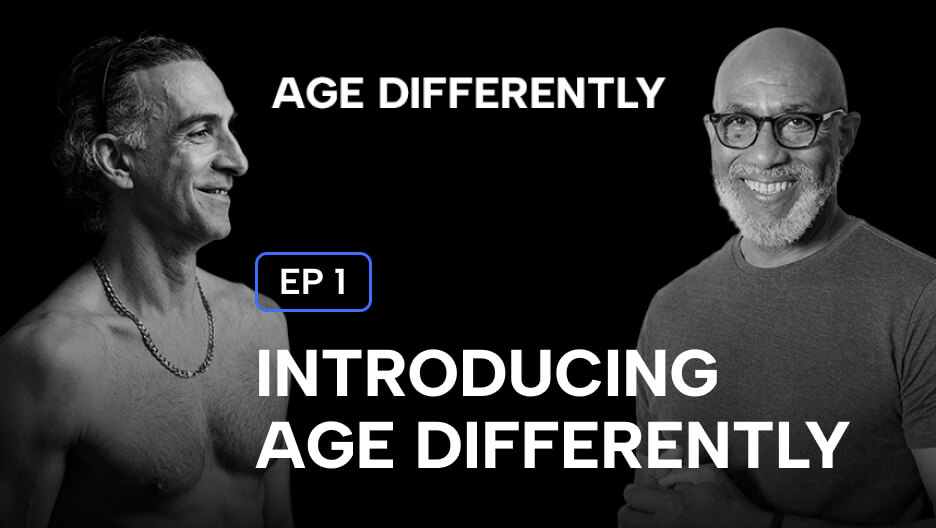
EP 1

Introducing Age Differently

In this episode, co-hosts Peter and Darius embark on their new podcast. After briefly introducing themselves and discussing how they formed this partnership, they introduce a variety of different topics including mindfulness, the importance of positive thinking, diet, exercise, emotional awareness, and the four elements of wellness—physical, emotional, mental, and spiritual–that need to be integrated. They briefly touch upon upcoming episodes, and conclude with Peter sharing a poem on peace and present-moment acceptance. Your hosts are here to offer the best men’s health podcast filled with meaningful insights to make a real impact on your life and vitality.

Key Points
  • Physical, emotional, mental, and spiritual health are interconnected and vital for aging with vitality and purpose.
  • Engaging in meaningful conversations requires vulnerability and authenticity, which can lead to deeper connections and less loneliness.
  • Mindfulness and being present in the moment can reduce negative thinking and improve overall well-being by allowing individuals to fully experience and appreciate life.
Automatically Generated
Peter
Darius!
Darius
Peter, it’s so good to see you.
Peter
My delight, I’m so glad we finally are here producing this podcast. How do you feel about it?
Darius
I'm excited, Peter. This is something that you and I have been speaking about for the better part of 2 years and to see that vision start to become reality. It's very exciting.
Peter
It's exciting. No question about it. Maybe we should tell the audience why we're here and what the name of this podcast is. Wanna do that?
Darius
I'd be delighted to. So the name we came up with is 50 to 70 Meaningful Conversations Between Men. Because in my experience and yours as well, men in our age category aren't really having those meaningful conversations, for a lot of different reasons.
Peter
That's true. And somebody who's 70 has had a few more years to learn a few things and had a few more bumps and bruises and maybe can share some meaningful things. And I'm not just talking about you and I, but our audience as well. How about from the perspective of somebody who's fifty?
Darius
Oh, someone who's fifty who's had more than a few bumps and bruises along the way. I'll take any wisdom I can to minimize bumps and bruises moving forward. But I think, as a fifty year old, you had an interesting inflection point. You've got kids that are likely in high school or about to leave, you've got elderly parents, you have a relationship with a significant other. You could be questioning what's going on in your life with your career. I think there's a lot of interesting dynamics that need to be covered and a lot of wisdom to be gleaned from somebody who's lived an extra 2 decades and been through it.
Peter
Yeah, and that 50 period, I recollect that midlife questioning, that conflict, that purposing. There's so much going on at that, like you said, inflection point. So, we'll get a chance to talk about it from a lot of different perspectives over the coming episodes. And from the perspective of somebody who's seventy, you know, aging and vulnerability starts to really set in deep. And so I hope to share some of that perspective and maybe glean, what, at 50, I might have done differently.
Darius
No, I think that's really profound, Peter. And I think you said a really powerful word: vulnerability, and it's not just the physical vulnerability, it's the emotional vulnerability, it's the mental vulnerability. That's one of those key things as a man that you're taught to beat out of your system. You don't show vulnerability, you don't show weakness because vulnerability is weakness.
Peter
Yeah, you don’t show emotions.
Darius
None.
Peter
So maybe we should tell the audience a little bit about ourselves. Darius, who are you?
Darius
Oh, who am I? My name is Darius Naigamwalla. I'm Canadian originally. Been down in the states for 20 years. I have 2 wonderful children who are both teenage boys and I'll get into more of my backstory and how I found you in a few minutes, but just really delighted to be here right now. And yourself, Peter?
Peter
Well, I am seventy, approaching 71, and the father of 4, the grandfather of 4. I'm very proud of my children. They've done well within the perspective of our culture and society. I'm extremely proud of my marine son who just, by the way, was awarded the bronze star.
Darius
Oh, that's fantastic.
Peter
And, the daughter was a nurse and ethicist. I have another one who's a leader in educational programs trying to keep teachers within the profession and develop more teachers in education and much needed aspects, and then I had my oldest son who's an occupational therapist. And so, you know, they turned out pretty good. And I must add, I also have a grandson who's a PJ, which is a, how do I best describe this, is a person who jumps out of planes in the air force and rescues pilots and goes into disaster areas and performs rescue. So, I'm very proud of my children and grandchildren. So, how did we come to get to this point where we're producing a podcast? Maybe we should share with the audience exactly what happened.
Darius
Yeah. It's such an interesting story. I was in my forties and living the corporate life. You know, getting on a plane every week, flying somewhere. I was a consultant to the biopharma industry. On the surface, I was crushing it. Very successful, I actually founded my own company that was doing well, but inside, I was just slowly physically deteriorating. I would travel, I would come back, I would not take care of the body and ice became my constant companion. It was chronic lower back pain that was getting worse and worse. And like any “healthy male”, I refused to listen to the weakness, I refused to acknowledge that it was there. I just willed myself to keep moving forward and the wake up calls started coming when I was in my forties and I ended up in the ER four times over the course of 2 years.
Peter
My.
Darius
Well, four times. A healthy man, once was a severe allergic reaction, once was pleurisy where the lung membrane starts to separate from the lungs. And twice, I had lower back pain where I showed up and rather than being straight, I was bent at a forty five degree angle to the left, and I couldn't straighten out.
Peter
May I ask you, were there any signs that gave you a warning that this was about to set in?
Darius
Oh, there were plenty of signs. There was the ache, there was the inability to get out of bed in the morning, there was the physical fatigue, there was the spiritual cognitive dissonance where I knew I wasn't doing what I was meant to do. But the question is, did I pay attention to any of those signs?
Peter
So, when did you wake up?
Darius
When did I wake up? Well, my back pain got so bad. I was at a Christmas party. I was hosting a Christmas party for my company. Fifty people there and I had my assistant with bags of ice that she would bring, and I would quietly step out and I would strap bags of ice around my back, tighten it up, she would come by in 20 minutes. She would gently take them and thank you, Christine, for doing that and helping me. 20 minutes later, she'd bring another set. And it was when I couldn't get out of bed in the morning that I realized there was a problem. So I actually ended up calling this wonderful therapist. His name was John and he convinced me of something that I never thought was possible. He convinced me that a majority of my back pain was in my head.
Peter
In your head?
Darius
In my head. Exactly.
Peter
And what was your reaction?
Darius
My reaction was bull, you know what? What the “f” does this guy think he's talking about? But he got me. He encouraged me to read a book, “Killing through Mindfulness,” by an individual, Ron Siegal and I read the book and I came to learn that a big chunk of it was in my head and how I was preparing for the back pain which may or may not come and how I wasn't living in the moment, but either thinking about the past or worried about the future. And that led to me deciding to take a mindfulness class, my friend.
Peter
Oh, you did?
Darius
I did!
Peter
I think I vaguely remember and who was it that you took this mindfulness course from, may I ask?
Darius
You can because my first interaction with him really struck a raw nerve with me.
Peter
Did it?
Darius
It did. Do you remember the first thing that you said to me when we're going around the room?
Peter
I'm just vaguely, and, I did notice your reaction to it. But I was mum and I just kind of knew to just let it sit with you a bit. You wanna share with the audience?
Darius
Oh, I'd be happy to. So at Peter's mindfulness class, we go around and we say why we're here. And so I think about what I'm going to say, and I say “ I'm here to get inside my mind a little bit.” And Peter takes this pause, as you’ll hear, Peter will take a pause and it’s usually before he says something really profound. And then he responds, “I would encourage you to get inside your mind, your body, as well as your emotions,” and then he moved on. And we were on Zoom because this was in the height of COVID and my reaction was, “Who does this guy think he is? This is not the class for me, I am not gonna be here.” I actually texted my significant other saying, “I can't believe I signed up for this class. This seems like a complete crock of you-know-what.” And then I breathed and I realized if you hit a nerve that quickly and that easily, there's something that we need to explore.
Peter
Mhmm. Yeah.
Darius
So that's how I ended up having the pleasure of getting to know you.
Peter
Well, that's wonderful. And then from there, we did some other things as well, right? Do you wanna share that with the audience or is that for future conversations?
Darius
Oh, we've done a lot of things and I think the beauty of what we're gonna be doing in this podcast is the conversations that you and I have been having, we're gonna be able to share some of the insights that we've taken. I mean, some of the topics that we're going to cover as we move forward, male relationships, and how as we get older, men don't have relationships with other men that they can pick up the phone and call and have conversations with.
Peter
Yeah.
Darius
We’re gonna talk about diet.
Peter
And nutrition, right?
Darius
And nutrition and supplementation and what the standard American diet is doing and things that we can do about it. We're gonna talk about mindfulness and, you know, you'll see farther when you stand on the shoulders of giants. That's what I get to do from a mindfulness perspective with you, but there are just so many topics.
Peter
But why would people wanna listen to us, Darius? Why would the audience care to tune in? What's there for them? What's the point of it though, often the way I look at things, what’s the point of it for them? What’s the why?
Darius
What’s the why?
Peter
What’s the why?
Darius
You mean, not just our good looks that they get to hear coming through the podcast and maybe see on video at some point. I think between the two of us, we have 120 years on this planet, almost 122 by the end of this month.
Peter
Yeah.
Darius
There's a lot of accumulated wisdom. A lot of stuff that you and I have spent hours, days, weeks, months, researching.
Peter
May I interject?
Darius
Please.
Peter
I hope the audience remembers this. 31,500,000 moments each year of your life.
Darius
Peter, how did you get to 31,500,000?
Peter
Just add up the moments each day, 365 days in the year.
Darius
Each day, 24 hours, each hour, 60 minutes.
Peter
Yeah, and we don't often step back enough to kind of look at what's the impact of that. Every one of those moments has an impact.
Darius
Absolutely.
Peter
And ripples out into our present moment. And we're not conscious, we're not aware of it.
Darius
Yeah and I’ll tell you the biggest insight I took from your mindfulness class was when we did the pleasant moments exercise. Do you remember that one?
Peter
Yeah. Yeah, of course.
Darius
So for those who haven't been through it, every day, you write down at the end of the day a pleasant moment. And so I wrote my 7 pleasant moments down, I had a really good week. Then Peter asked the question, “How many of those moments were you there for?” And I looked down and I had been present for 2 out of the 7 pleasant moments. The other 5, I was somewhere else. Physically there, but not mentally.
Peter
Yeah. And that's part of the challenge of our human condition, not being here, not being present. And we'll talk about that, and we'll talk about it because it has such an impact on the joy of living our lives, the abundance we're able to experience and really how much it contributes to just the constant negative thinking about what happened in the past or what you're worried about in the future. So much of this has mindfulness context to it, but it's not about mindfulness. It's about being awake and aware and being present.
Darius
Yeah, but there’s so much more, if you think about the conversations that we've had over the last 2 years. We've talked about parenting. We've talked about, I don’t know how to say this, parenting your parents as they become more elderly.
Peter
Yeah.
Darius
We have talked about grief.
Peter
Yeah.
Darius
Right, we have talked about diet, nutrition, and supplementation. We've talked about exercise and how the body needs exercise and what happens when you don't exercise. We've talked about stress, the insidious nature of stress, all these are podcast topics that we're gonna get into.
Peter
Yeah. Speaking of stress and speaking of self care, do you remember our conversations about self sabotaging ourselves?
Darius
I do, but why don't you illuminate people on self sabotage? I think that's a pretty powerful concept.
Peter
Well, it's just the unconscious conditioning and habits that we've engaged in for moments, remember millions of moments –
Darius
31 and a half.
Peter
In order to cope with the discomfort, the pain of something unpleasant in our lives. You know, we throw around the term “trauma” a lot these days. And perhaps rightfully so, there's lots of concepts and in ancient literature that talk about these experiences we have in our lives that leave imprints in our psyche. And one of the things I've learned over the years in a lot of interactions like the ones you and I have had, over these last couple of years, is through the coaching that I've done, the mindful life coaching, the teaching of the classes, from a mindfulness perspective, the NBSR, the mindfulness based stress reduction classes, the opportunity to see the human psyche at work and how I've learned there's these imprints that we now often refer to as trauma that are left on our minds and then we act to avoid. We spend most of our lives pursuing ways to cope with things that are negative and we start doing it unconsciously. And then we get kinda lost in that loop of negativity. We get lost in behaviors where we're coping, trying to avoid the experience again. But we are unconscious of the feelings that promote it. The feelings that generate the thoughts, the negative thinking, the coping, the stress. And so a lot of what, you know, we can call it mindfulness, but it's more than that. A lot of just being aware and awake can help you and me be more apt to manage and regulate it better
Darius
So I'll take that concept and I'll put it into practice. When my back was really bad, I was constantly thinking about what not to do to trigger it and so my range of activities got progressively lower and lower and tighter and tighter until it was nonexistent because I was living in my head about what might happen.
Peter
Negatively, right?
Darius
Very much so. And then I was getting, I don't know if the right word is, martyr? But I was “Woe is me. Why me? Why do I have this?”
Peter
Victim.
Darius
Victim. That's the word, thank you! Looking back now, I'll tell you that the back pain that I went through, probably one of the greatest gifts I've ever been given because it caused me to re-examine everything and to look at how I was living my life and I wouldn't have done it if I didn't have that experience.
Peter
Yeah. Yeah. Oftentimes, my experience I'll share is that some of my biggest disappointments and failures have been my best moments to learn and to evolve and grow and develop. And so I can see that that happened to you. I'm delighted for you, actually.
Darius
So I have a cousin. He's like a little brother to me and he's a very powerful man. And we were talking about failure when he was down visiting me and he's like, “There's no failures, they're just opportunities for us to grow.”
Peter
Yeah.
Darius
And if we choose to make it a “failure”, well, that's how we're gonna see it and that's how we're gonna live it. If we choose to take it as an opportunity to learn, to make ourselves better and to come back stronger, that's how we'll do it.
Peter
Yeah and we'll talk about this aspect as well. There's science out there that talks about how much time we as human beings spend with negative thoughts and negative thinking. It's anywhere from 70 to 80 percent of the time. We wander off distracted by something in our mind that we view and emote and feel as negative. And you and I have talked often about what about the other side of this? What about the side of being positive and reflecting on an opportunity and taking a risk and being okay being outside of the box? Correct?
Darius
Absolutely, and if I think about the 70 to 80% that's negative, we have the negative, and then we have a big chunk of time that I think is increasing where you are just numb and what I mean by that is you've got 5 minutes at the bank line. What do you do? You pick up your smartphone and you start scrolling through Instagram or Facebook or TikTok or whatever it is. Versus just sitting and experiencing being in your body in the moment and there's so many ways to numb yourself. TV, alcohol, drugs, sex, it's all the same thing. I don't want to think, I just wanna take my brain and park it to the side for a while.
Peter
So from your experience, why? Why the numbing?
Darius
Because emotions can be painful.
Peter
What does it have to do with emotions?
Darius
Well, I do think the emotions are what drives the numbing.
Peter
Are we avoiding them?
Darius
I can speak only for myself and my emotions. There were years I absolutely avoided them!
Peter
Yeah. Yeah. And I have as well. And it's helped to develop these practices in this capacity to be more present and be more aware and more awake. I like the term you use, you often use the term awake. Because it awakens you it makes you aware of the fact that you're engaging in conduct and actions that don't serve you being here and now and they're just an avoidance of the emotion that you're feeling and you're hiding from the emotion, you're not acknowledging it. You're not aware. You're not awakened to it. And so, it's just this vicious loop that keeps you in a perpetual, call it a mist, call it a fog, the dark. I don't know what we wanna call it.
Darius
I don't know. When I think of the word awake, that word is used a lot from a political perspective. And I'm not talking about it from a political perspective. I'm talking about understanding what is going on within yourself. Are you conscious of your emotions? And one of the things that I think I told you is sometimes when I think I'm awake, it means I'm actually in the middle of the deepest slumber that I've ever been in. And it's definitely a work in progress, constantly striving to become more aware, more awake of what's going on because if I play my argument all the way through, it means even right now, part of me, not the majority of me, is still asleep.
Peter
And right now, at this moment, being asleep. What is your perspective of where to move forward with that, how to continue to evolve. What do you do with that awareness, that awakening, that consciousness?
Darius
I think, like, one of the insights I've had in life is there's very rarely a silver bullet simple answer to anything. Life is a series of small steps taken in a consistent direction that cumulatively adds up to something great. So if we go back to your question, it just means I keep practicing. I keep acknowledging when the tough feelings come up: anger, sadness, loneliness, grief, whatever they are and I sit with them. Make peace with them because they are going to be there and if we just refuse to acknowledge them, at least in my experience, they're gonna come out again at some point in time, either emotionally or physically.
Peter
Yeah. So are those the themes around which to have meaningful conversations?
Darius
If I think about the meaningful conversations I've had, there's one underlying theme: that’s vulnerability. Because you can't have a meaningful conversation with another human being unless you're being vulnerable and authentic with who you are and what it is you are going through. And-
Peter
So-
Darius
Sorry, go ahead…
Peter
So it sounds simple enough, why are we so challenged? Why are you so challenged to be vulnerable or were maybe so challenged or maybe I was and maybe still am to some extent?
Darius
I think everybody's challenged because being vulnerable is scary.
Peter
Yeah.
Darius
Right? You're actually showing the world who you are and you're showing other men that you don't have it all together.
Peter
Yeah.
Darius
And there's that fear of being rejected and honestly, Peter, sometimes I've put myself out there and the person has shown me that they're not interested and I don't take that personally anymore.
Peter
Mhmm.
Darius
I just thank them for being true to who they are and I go to somebody else who I know, when I can have that conversation, will respond in turn because two vulnerable people, they always find a way to connect if they're being truly vulnerable and authentic.
Peter
Yes. Yes. True. And the person who doesn't choose to be vulnerable, what's your thoughts, your thinking, your feelings about their situation?
Darius
Again, from my personal experience, and I’d love your thoughts, you're lonely.
Peter
Could be.
Darius
Right? You're cut off, you're isolated, and you're not living your authentic life.
Peter
We're not here to judge.
Darius
No.
Peter
And I would hope that our audience understands that. We're here to invite exploration into areas that maybe people haven't chosen, men haven't chosen to look at. You know, why are you challenged to be vulnerable? Where did you learn to not acknowledge that you're afraid or that you're angry? And so, our conversations hopefully will show some light on where those mindsets and those attitudes come from.
Darius
Yeah.
Peter
And where the perceptions derive, maybe the judgments. And, again, we're inviting the audience, I’m inviting the audience, just take a look, step back and take a look. See if it applies to you and see if it makes a difference for you.
Darius
Yeah. If I think about the series that we're creating, it has four elements and they all have to be in balance. You have physical, emotional, mental and spiritual. We will be talking about things that are highly physical: exercise. Now knowing you and I, we're gonna talk about how to incorporate breathing and your mind into that exercise to create a different experience.
Peter
So good segue, why physical? Why does it matter?
Darius
Why does being physical matter?
Peter
Why does having a conversation, an episode or a talk about being fifty and concerned with your physical well-being or 70 and your physical well-being? Why are these, at this age, these topics that you mentioned, why are they important first?
Darius
Well, I was doing some research last week: 30,000,000 Americans have diabetes, 100,000,000 Americans are prediabetic. The total cost of diabetes to the United States is in the trillions of dollars. Think about all the suffering, physical suffering. Think about low back pain, think about all of the autoimmune conditions that are increasing in frequency, think about the soaring rates of obesity. We live in our bodies, we have to take care of our bodies.
Peter
But what about the mindset or the attitude? This is just my bad luck. I'm diabetic or I'm prediabetic, you know, it's you know, unfortunate, but that's my autoimmune condition. There's nothing I can do about it.
Darius
Yeah. That's an interesting mindset and one that we're gonna get into in a lot more detail, yes, going back to the victim.
Peter
So I interrupted you, there were 3 others.
Darius
So we've got physical, we've got emotional: emotional state of being. Mental: what's going on inside your head? Are you happy inside your head? And then what kind of ties it all together is that spiritual, that meaning, that purpose. So we'll be talking about all sorts of different topics designed to hopefully improve vitality and to age differently and to age with vitality between 50-70 and avoid a lot of the lessons that you and I've learned.
Peter
Yeah. I just want to caution that when we talk about spiritual, it has this other aspect of energetic as well, at least when I talk about it, and it's not necessarily philosophical or religious.
Darius
Agreed.
Peter
It has aspects that are more practical. I think a lot of our conversations are about practical applications to the human condition, to living life. I wanna make sure that the audience understands that when we're talking about mindfulness or yoga, we're not talking about higher consciousness kind of concepts, we're talking about practical day to day applications on how to live your life with more joy, more abundance, with less pain. To live your life with more gratitude, you know, just things that are applicable every single day, every moment of every day.
Darius
To have the human experience and actually fully experience it.
Peter
Yes. Yes.
Darius
So with that as a transition, at the end of every podcast, we're going to do a call to action. An invitation to our listeners to try something potentially a little bit different. So it's our first podcast. What should our call to action be on this one, Peter?
Peter
Well, we talked about this. And we wanna invite the audience to have a meaningful conversation with someone every day. Just pause and let's say, ask them: how are you doing? And really mindfully listen as if you care how they're doing and when they ask you the same, don't gloss over it. Talk about what's going on with you, are you having a bad day and share that with another human being. And just start building a different way of connecting with one another and building community that isn't superficial. That isn't just focused on distractions like I got a new car or I have a house, I have this repair to do or I'm going to see this movie. No, how are you feeling? How are you doing? How are you physically? How are you mentally? How are you emotionally? You know, I keep repeatedly encountering that there's a lot of depressed states of mind out there since COVID. And for a number of other reasons, people are lonely, So maybe there should be, could be, more conversations that are meaningful so that these states of mind, these states of emotions, these physical states aren't so depressed. And so that's our call to action. Go out and have a meaningful conversation with someone. As often as you can every day.
Darius
I love that call to action. It's a nice set up for what our next podcast topic is gonna be.
Peter
You wanna share that?
Darius
Absolutely. It's a conversation, our topic is near and dear to my heart, it’s male friends. Why are they so important and for those of you that have let your male relationships lapse, like, I would posit most of the audience. How to get them back? How to rekindle those sparks?
Peter
That's really exciting. Yeah, I'm excited because I am guilty of having let some of my male relationships lapse over the years and I've learned from you and I've learned from others how to do a better job now even at 70.
Darius
Peter, this was awesome!
Peter
I'm so glad we finally got around to doing this. You know, we talked about ending with a poem,
Darius
Please!
Peter
Or a quote. And so we'll end this podcast with this poem. The name of the poem is “Peace Is This Moment Without Judgment.”
Do you think peace requires an end to war?
Or that tigers eat only vegetables?
Do you think peace requires an absence from your spouse or your boss, or maybe an absence from yourself?
Do you think peace will come some other time than now?
Some other place than here? Or in some other heart than your own?
No.
Perhaps peace is just this moment.
This moment in the heart space, where everything that is, is welcome.
Peace is this moment without thinking, thinking, thinking, it should be some other way.
It should be only as I, according to my plans, as I want.
Well, perhaps peace is just this moment, without judgment.
This moment in your heart space where everything that is, is welcome.
Darius
That's just beautiful. Peter, thank you.
Peter
Thank you Darius.

Disclaimer

The “Age Differently” website and associated podcast (the “Podcast”) is intended for educational, entertainment, and informational purposes only. The Podcast is not intended to provide medical advice, diagnosis, or treatment of any health problem or disease. There is no doctor-patient relationship between you and anyone appearing on the Podcast. Always consult with your doctor or other qualified healthcare provider regarding any and all medical decisions. Do not disregard any medical advice or delay consulting with a health professional because of anything you hear on the Podcast. If you think you may have a medical emergency, call 911 or go to the nearest emergency room immediately. Any claims about possible health benefits conferred by any foods, supplements, or activities discussed on the Podcast have not necessarily been evaluated by Food & Drug Administration or any other institution or regulatory body. The ideas and opinions expressed on the Podcast are personal to the individuals expressing them, and do not represent the perspective of any other person or institution. The Podcast is provided on an “as is” basis and with all faults. Neither the company nor its employees, nor any contributor to this website or podcast, makes any representations, express or implied, with respect to the information provided herein or to its use. Any reliance on information discussed on the Podcast is entirely at your own risk, and no one who appears on the Podcast shall be liable for any resulting losses or damages.

Read More

image

Our Newsletter

Reflections, reminders, new episodes, and tangible applications delivered to you.

Loading