
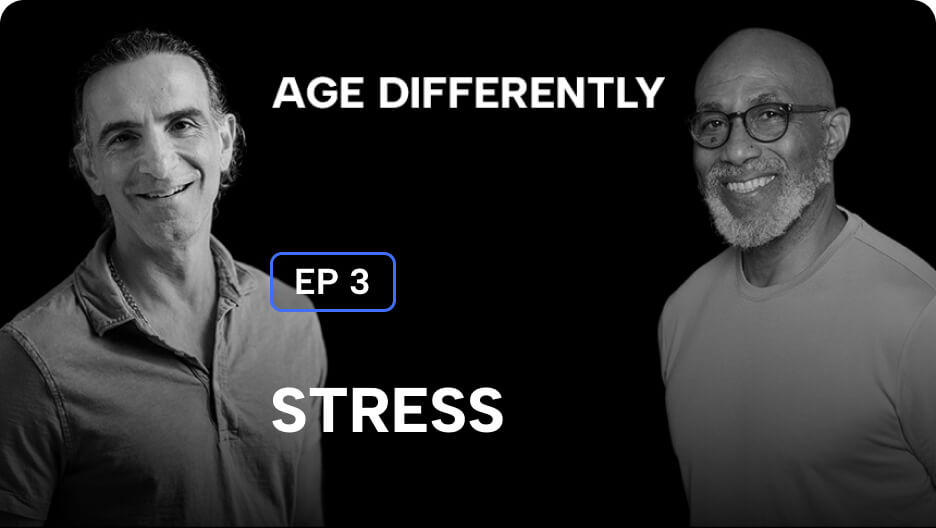
EP 3

Stress

In this episode, Darius and Peter delve into the topic of stress, its effects, and the body’s various responses. They discuss societal perceptions, different stressors, and the role of learned behaviors. They identify stress triggers, explore physical and psychological manifestations (both short and long-term), and share various techniques to help listeners identify unconscious feelings / behaviors and adapt healthier coping strategies. Understanding stress and developing solutions is at the foundation of this men’s mental health podcast. The episode concludes with a poem, “Being Human,” and a teaser about aging with vitality.

Key Points
  • Recognizing and admitting to feeling stressed or anxious is a powerful step towards managing stress and choosing how to respond to it consciously.
  • Long-term stress without proper management can lead to a multitude of maladaptive coping mechanisms, ultimately creating mental and physical health issues.
  • Practices such as meditation, physical exercise, engaging in self-care, and open communication can be effective strategies.
Automatically Generated
Darius
Welcome, everybody. I'm Darius, and I'm fifty years old.
Peter
And I'm Peter, and I'm seventy.
Darius
And we invite you to have a listen into this meaningful conversation between men. Peter, good to see you.
Peter
Good to see you, Darius.
Darius
How's the day going for you today?
Peter
It's been great. It has been wonderful. The days and moments I've learned are always something to be grateful for.
Darius
Absolutely. During our last podcast, we talked about relationships between men. And today, we're gonna switch gears a little bit. And talk about something that everyone on this planet encounters on a daily basis, the insidious beast that we call stress.
Peter
Yes. Yes. A topic that is very much on my mind all the time because of the work I've been doing over the last decade. The work that I continue to do with individuals and groups that mindfulness is intended to affect. This isn't about mindfulness.
Peter
This episode is about stress, and stress is present regardless of whether or not you have mindfulness. And it's insidious. We're designed to use stress to our benefit. But with modern civilization, modern stimulation, modern distractions. Stress has become something that negatively affects each and every one of us.
Peter
This modern world, it just seems to be, almost apocalyptic moment to moment.
Darius
So I think we probably should, you know, take a step back and define stress so that people understand what stress is. And then talk about the pathophysiological reactions that occur in the body and the mind as a result of stress. I'd love your thoughts as well on the long term consequences of stress.
Peter
Yes.
Darius
And then I think most importantly, like we try and do in all of our podcasts, is bring it home and give people tangible things that they can do in response to stress. I mean, we're trying to cover a lot on this one.
Peter
Well, this is a topic that can't really be covered in a 30 minute podcast. We'll do our best to highlight concepts, experiences, maybe some tools and techniques that our audience might use.
Darius
Yep.
Peter
And give them information, maybe a little bit more knowledge that could be helpful to them if they choose.
Peter
That's an inside joke, by the way, for the audience is “if you choose”.
Darius
We'll get into that in more detail. So, Peter, let's start about defining stress because you hear about it all the time. It's one of those words that is ubiquitously used. Do you hear about it every day?
Peter
Yes.
Darius
What is stress?
Peter
The definition that commonly is used, it's the response of an organism to demand or pressure. To me, that doesn't fully cover and doesn't really get into what is stress? For human beings, it's the activation of your sympathetic nervous system in response — and I use this word instead of demand and pressure because I think it makes it more visual. It makes it more tangible. It's a response to the perception of a threat. Okay. We're hardwired for it, and it helped us survive as a species.
Peter
A lion, a bear stalking us. We either would fight or run away, flee, or we would hide. And in order to do that, we needed to be at our optimum. And so our physiological mechanism is designed to generate necessary chemicals, cortisol, adrenaline so that we divert the performance capabilities where they're most needed. We don't need it for our digestion at that point in time.
Peter
We need it for clear cognitive functioning and optimum physical muscular performance. And so that's what the sympathetic nervous system does. It activates those aspects of our physiology.
Darius
So from an evolutionary perspective, our response to stress was very healthy when we were in a life threatening situation, we had the strength to fight, the energy to flee, or we're smart enough to know we needed to freeze. I guess that's kinda like those stories you hear of a parent whose child is in imminent danger lifting up a car or moving something off of them.
Peter
Yes. Doing things that are virtually superhuman. When in actuality, maybe that just kind of further shows we have capacities that we're not aware of.
Darius
But as I think about it, I agree with that. I can see in my 50 years I've never once encountered a lion or a tiger out picking berries. I've never had that kind of life threatening situation presented to myself. It seems like it's been hijacked for lack of a better word.
Peter
It is a great word. It's morphed. It's mutated. Into an adaptation that kinda corrupts the beneficial aspects of stress and what it was designed for. It takes it to a level where everything, many things are perceived as imminent threats.
Peter
Think about this for a second. The email, the text. The social media posting.
Peter
Those are perceptions. Those are judgments that are made that this is threatening to my well-being, but it's not really threatening to your physical well-being. It's just something that we have become conditioned, habituated to interpreting as threatening to our overall well-being. Some of it makes sense, you know, because we've adapted the social norms of our cultures.
Peter
And so financial well-being. Right? Having a roof over your head, a place to sleep. Some of that makes sense. But think about this for a second, Darius, we've moved from this as a survival technique to now this is a reactive experience to something we perceive. And that's insidious and so stressful. Well, actually, that's just the beginning of it. The real insidiousness of it is that every time we have one of these spikes of cortisol and adrenaline, the body activates. And the physiology gets really active and ready for danger and to react, to fight, flee.
Peter
Be at optimum ready. But then nothing happens. There's no lion. There's no tiger. And so what happens to these chemicals we've generated?
Darius
So I can give you an example. A couple of spring to mind. One is I think about public speaking. Public speaking is a major stressor for many people. I had a friend in Public School who was absolutely terrified of public speaking, and I sat beside him in grade 4 or 5 and we had to do orals. 3 or 4 minutes on the topic of your presentation. I watched him for the hour leading up to his presentation as his pathways got activated. And his pathway that was activated was flee. He didn't freeze. He didn't fight, but he had flee, and it started with his hands. I could watch the sweat dripping off of his hands. As he was nervous. And then he was clenching and moving them like this and then rocking in his seat a little bit. By the time he got up to speak, he was so wound up to get out of there.
Darius
The words that came blurting out of his mouth were a garble. Nobody could understand them. And he had to stop and go back and try again because that healthy pathway had been triggered, and he was responding with flee, but he couldn't flee. And so that spiral just went out of control.
Peter
Yeah. That's what happens. And yet we tend, our society, our culture, perceives, believes, that stress is a good thing in some instances, and one of them is public speaking.
Darius
Oh, you have to explain that to me.
Peter
Well, if all of your optimal performance capabilities can get activated, in particular, clear thinking focus, which stress does, then it can serve you in certain instances. Like, when you're getting ready to speak in public before an audience and you're feeling this trepidation, you're feeling this fear, you know, you wanna make sure that you stand up there and be clear. But what's happened, we'll talk about that for a second. The other area is competition. Especially competitive sports, where activating your stress mechanism, again, in theory, is intended to bring you to optimal performance.
Peter
You're ready to go. Here's the challenge in modern times. It comes these days, I perceive, I believe, my experience in the field with a certain emotionality. And that emotionality, let's take, for instance, fear, fear of failure. It works for a while, but then the mental capacities begin to erode.
Peter
You're not focused. You're not clear anymore. You're more in fear than you are in active, optimal performance. I've seen that a number of times. Have you?
Darius
I just think back to going back to the public speaking example. There's 3 pathways. And if my flight pathway gets activated, that may be helpful. May.
Darius
If my freeze pathway gets activated, that's clearly not helpful. And I've seen that, unfortunately, where people get up to deliver something and the deer in the headlights look takes over. Yeah. If their flee pathway gets activated, that's even worse because every step even getting out on the stage you can see is a constant battle for these people.
Darius
I've done a lot of public speaking. And early on, I became cognizant that I have a crutch. I can't sit still when I'm speaking. I have to move because I have the fight pathway activated, and I have all this energy. And if I sit still, I get jittery and I can't focus. I remember I was doing a pitch once and my boss, I was moving around and doing a good job.
Darius
My boss leaned over and said, “if you move your feet one more time, I'm going to the store, and I'm gonna get a hammer and some nails and I'm gonna nail you to the ground”. I'm in the middle of a great pitch. So I stood still for 3 minutes and everything started to unravel. I couldn't answer basic questions because all I was so focused on was keeping my feet there.
Darius
And so after 3 minutes, I realized the ludicrousy of the situation. I leaned him and said, it's time for you to go to the hardware store and get that nail. And I started moving again because that stress pathway had been activated and I can tell you, Peter, my response to it for years. It's not there. I don't feel it. I ignore it.
Darius
Yeah. Let me just push that down, and I'll get through it, and it'll be gone.
Peter
Yeah. I wonder how many people, how many men in our audience, do the same thing. Have you ever thought about that? Do you ever witness that with your friends or acquaintances or colleagues?
Darius
Absolutely.
Peter
Stress doesn't exist. Why do we tell ourselves this? Do you have any idea, any experience with it?
Darius
No. I got a lot. If you admit that stress exists, part of you thinks you're weak.
Peter
Yeah.
Darius
Part of you thinks you're incapable of handling it. You're not independent. You're not confident. Versus what I've come to learn, it is so powerful to acknowledge that stress, to name the stress, to say how you're feeling, to embrace it, and then to either let it flow and move on or to not internalize it, but to really capture it and manifest it so that it doesn't become resident in the body.
Peter
Yeah.
Darius
Because if I think about stressors, there's financial stressors. There are stressors with interpersonal relationships.
Peter
Oh my.
Darius
Parents, partners, kids, friends. There are physical stressors. There's one of the greatest stressors that I see every day when I get behind the wheel of the car. And, otherwise, sane rational kind human beings become maniacs.
Peter
But all of those responses. Have you noticed they're kind of like learned behaviors based on perceptions and judgments?
Darius
They are.
Peter
Like being in traffic, for instance. Why do we interpret that that's a threat? Now if somebody's not driving well, yeah, there's the possibility of an accident. I agree with that. I understand that. But in all instances, are we elevating the threat?
Peter
That's another example of what I'm talking about. And when it comes to stress, and starting to mitigate it and manage it. First, identifying it, yes, which you just highlighted. And then second, understanding its context. What is the situation and why is it being perceived as a threat?
Peter
And I believe that this is one way to start again mitigating, managing stress. Because once you've done that, then you can say to yourself, well, why am I choosing to view it as a threat to me?
Peter
Is it based on the current circumstance? Think about driving for a second. The accident hasn't happened. Just because somebody's driving slow or somebody cuts you off on the road, doesn't mean that you're going to have an accident. There are many moments before that happens, but yet you're already emotionally engaged with fear and anger.
Peter
And so being aware and conscious of how you're feeling, what you're perceiving, what you're judging, all of those things are incredible ways to start managing stress.
Darius
So if I think about a stressful situation, how it manifests in me. My breathing becomes more shallow.
Peter
Yes.
Darius
Okay. I feel a little bit of a tingling in the pit of my stomach. And interestingly enough, my peripheral vision, I feel it narrow a little bit. That passes rather quickly, but I'm curious. What are the long term effects of what I used to do, which is either not naming it – I would have all the sensations I just chose to ignore them.
Darius
What are some of those long term effects? How does the body respond over the next hours, days, weeks, months, what happens?
Peter
Well, fortunately or unfortunately, we're not like the zebra who after being hunted and escaping can stop.
Darius
Mhmm.
Peter
And I think most herd animals do this and kinda just violently shake and vibrate. And kind of like shake off the adrenaline.
Darius
Let it go.
Peter
Let it go. We don't do that. And so what happens? The adrenaline continues to reside within the body. And science is now replete with evidence that stress, whether it's acute, chronic, post traumatic, it manifests in disease, heart attacks, high blood pressure, diabetes, strokes, migraines, emotional disorders, mental disorders, eating disorders.
Darius
Mhmm.
Peter
Autoimmune disorders. I mean, I can go on and on and on, but the science is pretty complete at this point in time.
Darius
You want to explain something to me that I think would be helpful for our audience to hear? About how we are like a magnet as we go through –
Peter
Yeah.
Darius
You want to explain that one because I think it's real. And we're not gonna get on the topic of electromagnetic radiation, but –
Peter
Not today.
Darius
But I I think that'd be a really helpful construct.
Peter
Yes. I have come to explain stress in this way, especially chronic stress, especially the stress that sees so many things as a threat. There's two ways I describe it. And the first way is that every one of these stressful experiences is like a little shard of metal. Or a piece of metal that attaches to your body.
Peter
So if you could imagine millions of moments in your life where you've felt anxiety and stress whether you admit or deny it. Here comes another shard, another piece of metal, shrapnel, attaching to your body. And, yeah, immediately at the first instance, it's not a big deal. I can kinda get over this stress. I can handle this.
Peter
I have to handle this. I'm a man. But after time, and especially all that time that you have been ignoring it, just like a magnet, to which all these metal shards could attach. They attach to you, and they start to weigh you down.
Peter
Start to wear out your body physiologically. Also, mentally, we've learned. The other way I describe it sometimes is like every one of these incidents of stress is like a razor cut.
Peter
Some of them are deep. Some of them are shallow, but it doesn't take much to understand that after years or millions of moments. It just gets to be too much for the body. So I think that's a good way to kind of look at stress. And why I look at it as insidious and maleficent.
Peter
If we were to adapt it as it was intended, of course, it has benefits, but it's been maladapted at this point in time. I believe. I see.
Darius
So how do we start to reframe the brain to more appropriately respond to those day-to-day stressors that we are all going to encounter. They're not gonna go away.
Peter
No. They're not. No. They're not. But you said it earlier.
Peter
First, we have to enable ourselves to identify. I'm stressed. I'm anxious. And if you care not to conclude or bring yourself to accept “I’m stressed”, ask yourself, “am I irritated? Am I agitated? Am I aggravated?”
Peter
Because those are steps that lead up to anxiety and stress. And if you're experiencing those or one that I've heard quite often, if you tell yourself “I'm frustrated”.
Darius
But frustration isn't an emotion. I had a professor in business school who would yell: There's no such emotion as frustration.
Darius
It's a state of being.
Peter
Yes. It is.
Darius
It's not an emotion. You can be angry. You can be sad. You can be despondent. You can be upset.
Darius
But frustrated, and I'll never forget this man, Craig Pender was his name, it's a state of being where an outcome that you were striving towards is blocked.
Peter
Yeah. Oh, wonderful definition. Yes.
Darius
Yeah.
Peter
But it's not stress.
Darius
It's not stress.
Peter
And it's not the emotions that are not part of this triangle of stress. The triangle being your physiology, your body, the thinking that's going on in your head, the perception, the judgments, the emotions that are fueling or vice versa, accumulating, and it's just a triangle that continues in movement continuously. All of which activates stress. Some of it, unconscious autopilot.
Peter
I think big chunks of it are unconscious.
Darius
Yes. Learned behaviors, beliefs that you have. When x happens, I'm supposed to get angry.
Peter
Mhmm.
Darius
I'm supposed to respond this way.
Peter
And that's what happens. And I think often, especially in our roles as providers and protectors, men, often feel like they have to assume higher roles of responsibility and obligations in taking care of the household without fear –
Darius
Mhmm.
Peter
Without anger. And without acknowledging that it stresses you or makes you anxious which is the case. It happens. It happens to all of us. It's happened to me repeatedly.
Darius
Yeah. One of my warning signs now is when I'm stressed and I'm not acknowledging it, I'll usually look for someone to make the problem and to take it out on versus looking internally. Yeah. Definitely one of my, not one of my favorite character traits. But something that I've become cognizant of, and I am working on, right, looking in the mirror.
Darius
Okay. Why am I behaving like this? What is going on that is causing me to act this way because I'm clearly not the way I normally am. So there's something here that is stressing the system.
Peter
Yeah. So what is it? You mentioned identifying that you're feeling this way. Let's say we don't give it a name. We just say I'm feeling this way.
Darius
Not frustrated.
Peter
Not frustrated. And once you've done that, maybe you can ask yourself, well, what's my behavior as a result of it. And am I behaving this way because this is how I've behaved before?
Peter
In similar circumstances.
Darius
Mhmm.
Peter
And maybe whether you call it irritation, agitation, anxiety, stress, you start looking at the pattern of it. And whether you're doing the behavior, consciousness, or if it's just on autopilot, you do it unconsciously, just every time you're in a similar situation, or and I hope I can emphasize this. Feeling like you're in a similar situation.
Darius
Yes.
Peter
I'll repeat that. Feeling like you're threatened, although you're not.
Darius
Yeah.
Peter
Once you've done that, then you can maybe pause and choose consciously. Do I wanna behave this way, or do I wanna just keep reacting the way I always have?
Darius
Yeah. And it's recognizing, I think, that a lot of people definitely, in my experience, myself, don't recognize and own the role that they play in that stressful situation.
Peter
What do you mean?
Darius
Because you can be on autopilot because you could have learned patterns because you could have beliefs that may have served you well when you were eight years old or eighteen that no longer serve you well. And yet you are acting with those same beliefs and those same patterns and what you're essentially doing by not choosing to take a look is you're perpetuating the stress cycle because that's what you've become conditioned to.
Peter
Yes. I'm gonna ask you to repeat that about the beliefs and the patterns.
Darius
I wish I could remember what I said. So try again. Beliefs that you have when you're eight and they are, we've talked about this, those beliefs can come from anywhere and they get wedged in your body and in your mind.
Peter
Yeah.
Darius
And those patterns, those learned behaviors that you have that may have made sense when you were 12, 15, 20, those beliefs and those patterns no longer make sense. And taking that step back and looking at yourself within whatever dynamic it is to see how you are potentially contributing to, exacerbating, or heck, in many situations in my life, creating the stress.
Darius
I think about how many times you've had a bad day and you picked a fight with somebody. Because you didn't wanna look at the stressor.
Peter
Or you've had a bad day or you've had a day with an incident that caused fear and anxiety, and you get into a depressive state. You wanna hide away from the world. And I wanna challenge the audience today and ask yourself if you or anybody you know because of COVID and the incidents and the time since and the fears of global war and the fears of, terrorism, if you're not feeling a little bit depressed these days. And if it's not being caused by a certain amount of stress that you're feeling about life, your safety. My invitation to you is if you are in that moment, if you acknowledge you're feeling stressed, just take a moment and take a breath and look around you. Look around you and just kinda try to notice. Are you safe right now?
Peter
Are you okay right now?
Darius
Are you in physical jeopardy?
Peter
Yes. And if you're not, at least for the moment, maybe no need to stress. And you can choose it or not. And I don't think either one of us is here to tell people what to do because at the end of the day, it's what each of you out there in the audience decides for yourself to choose.
Darius
So we've talked about identifying and becoming aware. That you are stressed. We've talked about looking at the patterns and taking a step back to make a conscious choice. What else if someone is in that stressful situation?
Darius
That sympathetic nervous system has been activated. What else do they need to do to help regulate or to come through it in a more healthy fashion?
Peter
There are a number of practices and techniques that might be helpful. One of them I just mentioned, which was just pausing, and taking a breath and being conscious of your current environment, your current experience, but more important being conscious of the emotion you're feeling.
Peter
If you're feeling fear. You might ask yourself here. If you wanna delve into it. What am I afraid of at this moment? Did I learn this perception of fear somewhere? Or let's say you're angry, we were talking about in traffic. Did you learn to be angry because that's what those around you do? As you were growing up, learning to drive, etcetera, etcetera.
Peter
But are you really angry because of what's happening in that moment or something you learned before? And this happens in microseconds, micro moments. You then have a choice. You're gonna keep acting based on the experience of the past or learned behavior, the perceptions you were talking about, or do you wanna consciously choose to behave differently, maybe with less rage, less anger, take a breath, don't let yourself become overwhelmed with the adrenaline, the cortisol in that moment.
Peter
And that pause gives you that brief space. You can make that choice. And not go off in the direction of reactivity. You can actually literally respond.
Peter
And sometimes the place where that's most evident is when you're in communication with another human being. When something they've said unintendedly triggers you, activates you, enrages you. Not based again on what's happening in that moment, but something you're feeling, and now you're sympathetic nervous systems, your stress mechanisms are all at high level. You're getting angry by the words or the tone. And next thing you know, you're stressed by it and the communication begins to deteriorate.
Peter
So nice place. Nice moment. Take a breath. Make a pause. Notice your stress. Make a choice. Choose consciously and see what happens.
Darius
I love that. Some of the other things that I do. 1) I focus on my diet. I know that may seem totally counterintuitive to dealing with stress, but I've noticed there's a correlation between eating properly and eating balanced and reduced levels of stress. There's a reason people get hangry.
Darius
Right. There's a term for it. Hangry. You're hungry and you're angry. I'm thinking about it, and I will now say, I am getting hungry, and I am cranky because I am hungry.
Darius
So we probably shouldn't talk because I'm doing my best not to say something I don't mean. And the other thing that I've done for years, and I think it goes back to your analogy of getting that metal ball around you, and I think it pulls off a couple pieces of metal every time. This physical exercise, paired with breath.
Darius
And it can be the gym. It can be a walk. It can be a run. It can be swimming. It can be yoga.
Darius
Surfing, whatever you physically enjoy doing with your body, dancing, I found that if I'm able to physically exercise, and I'm at a highly stressed level or I'm feeling stressed, I can feel things resetting and the nervous system resetting, it coming down.
Peter
I'm glad you brought this up because it reminded me that there's one other thing that's constantly promoted as an antidote to stress but I'm gonna take a little different approach to it. We were talking about identifying and being aware of stress. Maybe we need tools to help with this. And one of those tools is the practice of paying attention, paying attention and being aware of each moment. Being aware when you're thinking, when you're distracted. And there's a practice that we know as meditation, and I believe somewhat misunderstood, that enables the capacity to pay attention, to focus your awareness, to move your field of awareness, however you need to, in a moment.
Peter
Almost impossible to do if you don't practice it. So that's what meditation is. You're just practicing that. Now it's kinda nice.
Peter
You can be calm. You can be soothed. You can be relaxed. But that's a byproduct. There are other benefits to meditation. And in the management and mitigation of stress, it's invaluable.
Darius
Yeah. There's two other ones I can think of, and we'll kinda weave those into our call to action this week. One is actually having a conversation with somebody about what's going on, just sharing what is stressing you with your significant other and sometimes just hearing the words come out makes you realize, okay, I'm making more of this situation than it actually is. Or if it is a very stressful, challenging situation, you've got someone there to help you think it through and navigate those challenges.
Darius
So, I guess called action potentially number one would be if you're going through something stressful, reach out and have a conversation with someone. And call to action number two, and you were having this conversation earlier today with our producer Alfonso, who is a wonderful guy, about the difference between self-care and being selfish. And there becomes a point in our lives where we need to prioritize self-care. And self-care can be anything. It can be going for that walk.
Darius
It can be taking your wife out for a special date. It could be hiking with the dog. It can be doing something just for yourself, like getting a massage that allows you to internalize and reset and bring those stress levels down.
Peter
Yes. Yeah. Those are all important points.
Darius
So as we wrap up another great episode, as always, this is gonna be posted on agedifferently.com. We would love feedback and comments from everybody, and we're gonna conclude with a wonderful poem by Peter.
Peter
So I invite the audience to, perhaps close your eyes if that's okay for you and just reflect on the words I'm about to share. Reflect how they feel and affect you in this moment and perhaps take it away for moments in the future as well. This being human. It's like a guest house. Every morning, there's a new arrival, a joy, a depression, a meanness
Peter
And then there's this momentary awareness that comes as an unexpected visitor. Welcome and entertain them all. Even if it's a crowd of sorrows, that sweeps your house clean of all its furniture. She or he may have been sent from Beyond. That dark shame, that malice, that thought, greet them each and every one of them at your door laughing.
Peter
Welcome difficulty and know the true alchemy that every human knows. The moment that you welcome your troubles a door opens for you.
Darius
Just wonderful, Peter. Thank you. Next episode is going to be aging with vitality and longevity. Lots to cover in that one, and we're looking forward to speaking with you guys all then. Thank you.

Disclaimer

The “Age Differently” website and associated podcast (the “Podcast”) is intended for educational, entertainment, and informational purposes only. The Podcast is not intended to provide medical advice, diagnosis, or treatment of any health problem or disease. There is no doctor-patient relationship between you and anyone appearing on the Podcast. Always consult with your doctor or other qualified healthcare provider regarding any and all medical decisions. Do not disregard any medical advice or delay consulting with a health professional because of anything you hear on the Podcast. If you think you may have a medical emergency, call 911 or go to the nearest emergency room immediately. Any claims about possible health benefits conferred by any foods, supplements, or activities discussed on the Podcast have not necessarily been evaluated by Food & Drug Administration or any other institution or regulatory body. The ideas and opinions expressed on the Podcast are personal to the individuals expressing them, and do not represent the perspective of any other person or institution. The Podcast is provided on an “as is” basis and with all faults. Neither the company nor its employees, nor any contributor to this website or podcast, makes any representations, express or implied, with respect to the information provided herein or to its use. Any reliance on information discussed on the Podcast is entirely at your own risk, and no one who appears on the Podcast shall be liable for any resulting losses or damages.

Read More

image

Our Newsletter

Reflections, reminders, new episodes, and tangible applications delivered to you.

Loading