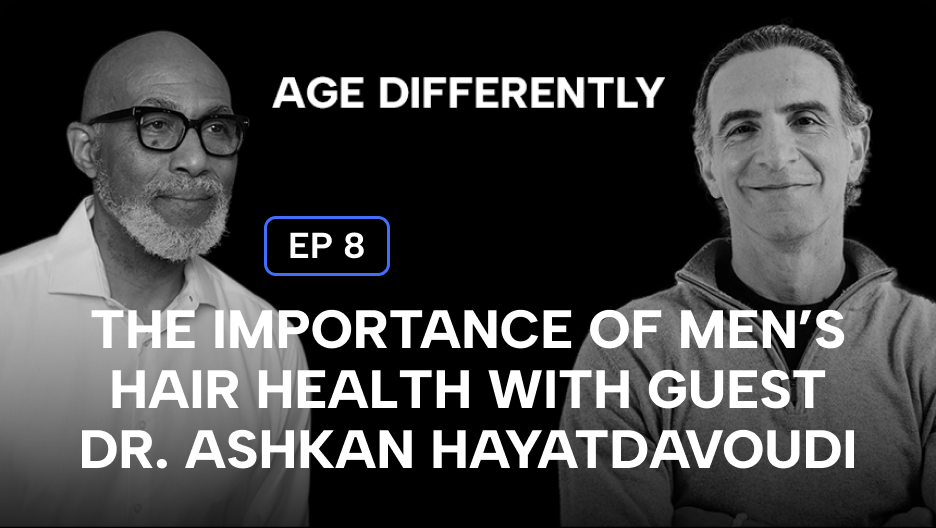
EP 8

The Importance Of Men’s Hair Health With Guest Dr. Ashkan Hayatdavoudi

In this episode, we dive into the world of hair rejuvenation with Dr. Ashkan Hayatdavoudi, a trailblazing physician, lawyer, and entrepreneur based in San Diego. As the CEO of Alvi Armani, Ash is revolutionizing the hair rejuvenation industry, offering everything from breakthrough products to state-of-the-art surgical solutions. Hosts Darius and Peter share their personal battles with hair loss—Darius opens up about his struggles at age 19, while Peter reflects on facing hair loss in his 60s. This episode is a must-listen for anyone curious about the intersection of physical & emotional health, personal identity as it relates to hair, and today’s cutting-edge hair rejuvenation solutions. Tune in to gain insights, inspiration, and a new perspective on managing and overcoming hair loss.

Key Points
  • Hair loss impacts both physical and emotional well-being, and understanding these interconnected experiences is crucial for addressing the issue holistically.
  • Stress and inflammation play a significant role in hair health, but with the right tools and strategies, stress-related hair loss can often be reversed.
  • From natural remedies to advanced surgical options, there are a variety of personalized hair rejuvenation solutions available, empowering individuals to find what works best for their unique needs.
Automatically Generated
Darius
Hello everyone and welcome once again to another episode of Age Differently meaningful conversations with men. My name is Darius Naigamwalla. I'm here with my co-host Peter Calin as well as our first guest Ash Hayatdavoudi. Welcome gentlemen, how are you today?
Ash
Morning Darius, happy to be here.
Peter
Morning, and welcome to our audience uh hopefully back for another meaningful conversation.
Darius
Absolutely so before we get started full disclosure I am an investor in Ash's company what's the old uh what's the old joke you know not not only the president of I'm a member as well um Ash is the one who started me on my journey of hair restoration so Ash personally just really delighted to have you on the on with us today and share with our audience you know hair health and options for men that are noticing hair loss and want to do something about it but before we dive into all that good stuff why don't you just tell us a little bit about yourself, your background.
Ash
Yeah, and Darius and Peter again. Thank you for having me. It's a pleasure to be here and talk to your base here. My background is, I'm a physician, lawyer.
Ash
I grew up in Southern California, born in Iran, been traveling south in Southern California since I landed here, currently in San Diego. I'm a serial entrepreneur with, currently involved with a couple companies. One of our companies is company named Presidium health that provides concierge level healthcare services to underserved members of our community that disproportionate utilization of the healthcare system and a value based approach. Sister company is really an enterprise of various entities, and that's that Alvi Armani enterprises, and what we mean by a conglomerate of different entities is is that what we really are is in the hair space, in the hair rejuvenation space, and we're in different verticals in that space, be it products for maintenance, products for hair growth, surgical solutions, minimally invasive surgical solutions, injectable solutions, the whole gamut of solutions for individuals suffering from hair loss and hair thinning.
Darius
Yeah, interesting. I remember Ash the first time I even considered going in hair rejuvenation. Peter, I don't think I told you this. We were on a board call. It was at the start of COVID, and we had been on it for an extended period of time, and I was feeling a little uppity or a little edgy, so I used to have this 90s rocker wig. So I went and put this thing on. Had hair down to here. I just wanted to see if anybody was still paying any attention on Zoom. And Ash looked at me and goes, wow, you look really good. You need to grow your hair again. I’m like that ship has sailed long ago. Oh, no, it hasn't. We're going to have a conversation. And that conversation sparked an interest and sparked the rejuvenation. So Ash, what's going on when guys are starting to lose their hair, right? Some, it starts at 18. Some, it starts at 20. But what's going on from two perspectives? One, physiologically, what's happening and then emotionally? What are you seeing men are experiencing?
Ash
Yeah, it's kind of hit that in a second. But I was just, while you were speaking, I was reminiscing on that day, what was that? Three years ago now?
Darius
It was four years ago now.
Ash
Yeah, four years ago now. That's incredible. Yeah, we were just talking, and then next thing, you know, Darius, my older brother, was running the company at that juncture, and was the lead surgeon. And this guy's a doer he's got his mind set on something he goes. Next thing I knew, he had visited the clinic and got the procedure, and it was, uh, it was pretty cool to see now, now four years.
Darius
Do I see something? Look at this.
Ash
Oh, oh, my God. That's, that's when, that's when you're really feeling yourself. That's, that's like. What we need is a before and after, but yeah and, you know, going back to your question that it relates, you know, you know, I would pass it back to you. You know, when we discussed during that conversation four years ago, we talked about that the option was there, you know, we didn't really go into how you felt up to this point, whether it bothered you or anything of that sort. It was, you know, the option is there and once you knew the option was there, you went forward with it. But before that had you know, was it something that you thought about, or was it just…
Darius
You know, yeah, it's an interesting question. So I started losing my hair at 19, and it was after the death of my father. I didn't process that very well. Moved away to school. Stress caused it, and I tell you one of the most disappointing, or I don't know what the word is, emotionally challenging experiences you have as a 19 year old is waking up every morning with a pillow full of hair, right? You can see it all just falling out. And then you start thinking, oh my gosh, I'm 19. I'm going to hide this for as long as I can.
Darius
Fortunately, that was the 90s baseball caps were good because it's embarrassing when you lose your hair, especially at that young in age, and then you start comparing and contrasting yourself. So for me personally, I didn't like it, and then I eventually, I guess, about four years in, came to the realization I can't stop this, so I may as well just shave my head and embrace it. I'm not going to hide it. This is what I have. These are the cards I've been dealt. And so I shaved my head, and then, as it progressively receded and got worse, it was just pretty normal. But I would pass it over to Peter right now, because Peter and I have had this conversation, and it didn't faze him at all.
Peter
Well, you know, it's, I started balding, really, in my 60s, the very top of my head. And it's, I think it's genetics, because my father and my brothers are all similarly. But for me, you know, this age of baldness being so kind of embrace it just, it just seemed like a natural flow. So we're having this conversation, and I'm representing, I think, that population that's kind of like, you know, hair. Why is that so important here? And you know, you know, you have an important viewpoint to share with both of you, and I think the audience should hear from Alvi, from Ash on, why is it that people come to him, what has been his experience? You know you represent one interest or one experience to rise. But how about the rest of the people out in our audience? What's a, what's a, what's an example, other examples of why people come.
Ash
Well. And you know, this played out perfectly, because, as you saw both of you, you know, sorry Darius for sharing. But if we're doing befores, you know, you guys had similar, similar domes, right? That physical manifestation had incredibly varying individual impacts on you. And my point in saying that is, you know, while hair loss is common, so you know, two thirds of men by the time they're 35 and 80% of men at by at some point in their life, 50% of women by the time they're they're 50 and 80% by the time they're 75 you know, hair loss is very common, but the impact of hair loss is incredibly individualized. It's based off of individual characteristics themselves with social pressures and extrinsic pressures. The person's been, you know, succumbed to in their life, what's important to that person, and what they what they hold as priorities, all those things kind of play into it, where each individual has a different, different type of response to losing hair.
Ash
What I would say is the individuals that find our group specifically are individuals that do prioritize their hair significantly, and that could be for a number of reasons. It could be for aesthetics, right? But. Which is kind of what we associate this with, but it can also be to mitigate loss. And so we go back to what Darius just talked about. You know, he went through his process. He began losing hair at first he was combative against it. He got sad a little bit about it, he got angry a little bit about it, and eventually he just accepted it.
Ash
Well, you know, that's called grief, right? So there's different reasons why an individual might come to our group specifically, but that's the general reason. It's someone that you know has lost what they once had, and what they're seeing isn't reflective of what they're feeling. And they want those two things to meld a little bit better.
Peter
This is
Ash
Have you, sorry, sorry to interrupt. Have you everybody's experienced loss? Is there anything tangible you'd be willing to talk about in terms of laws and how that progress went for you?
Peter
Yeah, yeah, I would, but it wouldn't be associated with hair, absolutely. But, you know, I, I have mentioned this in an prior episode. I left Michigan, I left a scholarship at a time that I was just overwhelmed with a number of things, fatherhood, distance from home, marriage, and so it was just, you know, a decision that a fork in the road that left me to abandon an opportunity that was the dream of a lifetime. You know, I was at the University of Michigan, and I was I didn't realize. I didn't have any context. I didn't realize I was on, I was a member of one of the greatest teams at the university, and but because I didn't play a lot, and because of all these other factors, I just made a poor decision. So that loss, that anger, and I want to come back to the emotions aspect of what you just mentioned, because it seems to be a theme that constantly runs in in our podcasts, in all of the aspects of the different topics we've talked about, and the importance of being able to identify these emotions and how they affect us in our lives, really.
Ash
Unless.
Peter
Go ahead.
Ash
Can I connect that story with with hair?
Peter
Yeah, please.
Ash
What would you do? What would you give to have that opportunity back? And I can tell you what it was for me. I had the similar experience with you and University of Michigan. I have what every, every person says at age 35, 40 I wish I could go back to college again and redo this and do it right. I spent, you know, I spent $300,000 going back to law school to try it again. What would you give to have that opportunity again? And that's the same thing with hair. They're not changing what they what they are. They want what they lost. That's why they come to us.
Darius
I would say, Yeah, Ash, it's not only wanting what you lost. It's wanting to take that, at least in my situation, it's wanting to take that and integrate it with where I am today, right? So I want to bring those two worlds together and have the best of both of them.
Ash
You want the ability to be able to do that?
Darius
Yeah.
Ash
It’s - we're not talking about aesthetics. We're talking about you had the ability to do that, to have whatever look you wanted on that individual day. Because you had hair, you lost that ability. You went through the stages of grief because of that, as well as hey, to resolve that loss,
Peter
Yeah, as well as a number of coping mechanisms that allayed, softened the grief, the loss, you know, the most obvious one was just, you know, shaving his head. But what else was going on? You know, what else happened in terms of, maybe his ego, what happened in terms of his self worth? You know, all of those things somewhat, you know, this is so multi-layered because it's, it's multi-layered because of the socio-cultural, the family aspects of it, and because we are not being mindful, kind of. Come back to this. We're not aware. We're not paying attention. We're too distracted, and we don't see what's going on with us. It took me decades, you know, kind of finishing the story about Michigan, decades to realize I was angry at life.
Darius
Yeah, what do I always say, Peter, when I think I'm awake, I'm in the middle of the deepest slumber ever possibly, and I think I'm awake now, which means somewhere I am, get asleep. I get I get it.
Peter
Yeah
Ash
But going from those things, we don't, you know, we learn from those things, and we progress forward as better beings is the whole.
Ash
The difference between Darius and I, that I see is we're kind of opposite ends of the timeline. It happened to him really early, whereas for me, it happened, you know, when I've generally, people start, men start to lose their hair. Do you see any differences there in terms of people who come to you.
Ash
Yeah and again, there's, there's a medley of things, right? You know? Okay, let's talk about females, right? It's a lot less socially acceptable for females to have hair thinning and balding, because it's not a known entity, right? Yeah, goes bald. They put on a wig. So we don't know what's going on in there, right? There's females that will stop going outside in public because their hair is thinning. I mean, that's you know, whether that's appropriate or not. Is, is a whole another issue, the suffering that goes with that, and the solutions that can alleviate that are another bucket in itself. And so, yeah, the younger you have it, the more prone you are to social pressures, the less developed you are as an individual. You know, those, those, those things definitely play into it, male, female, high level executives we had, you know, without going into specifics, we have individuals that are CEOs and, you know, high profile positions that prior to coming to us, they would spend two, three hours a day making sure that their hair was like before they left, putting in top wig, putting in, you know, different devices to ensure that no one would know that that they're losing hair, whether it has an effect or not to the perceptions of others. Who knows, but this is what's going on inside these individuals, which is torture unfortunately.
Peter
Yeah, I know that very well. I have a CEO client, female who had, and I want to get back to the topic of stress and the impacts of stress that Darius mentioned earlier, she had a million dollar deal gol turned sour. It was actually fraud that was committed against her and her company and she started to get into just a mental funk and started losing her hair. It started. And so I wanted to talk a little bit about the the relationship between stress and hair loss, if you would please,
Ash
Inflammation is the enemy, my friends. Anything that promotes inflammation is bad for the entire body from a holistic standpoint. And hair, you know, we take this out. Don't ever do that. It's a sin at Alvi Armani, by the way, to pull out your hair. But you know, like Darius said, 100 of these fall out a day. Look at this tiny little thing. We discount the fact that each of these little things is a full functioning organ, full functioning organ that is able to replicate, able to produce color, able to synthesize keratin into hair is able to do a number of things, right? So when you flood the follicles and the scalp with the actors with an inflammation. We don't go into those but it's not as exciting. Then, like anything else, it's going to affect hair growth. It's going to affect melanocytes, which are responsible for hair color. Is why you have significant graying or accelerated graying with increased stress. But, you know, we often think as hair loss is permanent, stress induced hair loss is reversible, and the faster you lose it because of stress, the more reversible it is, and again, not to get in the weeds, but there's something called telogen effluvium, where you could suddenly start losing clumps of hair, similar to what Darius was describing when he was, was younger, from his incident with his with his father. And that certainly happens, and it certainly is reversible, but you have to be educated with the tools and resources necessary to take advantage of that reversibility.
Darius
You mean, a case of beer doesn't help?
Ash
Oh, no, a case of beer is necessary. That's just, that's a given. That's not, that's not part of the strategy. If you have two cases, then you might our some in your hair too, and see if that has any effects and we can run to clinical study. Who knows be good for the brewing companies?
Darius
So we got stress, Ash. What else could be contributing to hair loss?
Ash
Anything that you could think of that you would say is bad for you, is bad for your hair, right? You know, when you think about the hair, it's it's in the skin and the head. So the scalp, you know, you want to make sure your scalp is nourished as moisturizes and dry isn't getting too much UV radiation. You want to make sure your nutrients are good, the stuff you guys were talking about. I think we were talking offline, Moringa.
Darius
Ashwagandha
Ash
I could go down the list, sage, saw palmetto, all these things are available, the growing body of evidence behind botanicals and their benefit and hair, skin and various other modalities, is vastly growing over the last few decades, and this stuff is becoming more and more commonplace to combat some of the issues, but other things in females, hormonal changes post pregnancy. You know, we're lucky as males. Females have a whole other slew of things going on in terms of hair loss. For instance, ours is androgen dependent. They have an androgen dependent mechanism and an androgen independent mechanism, just to convolute things. I'm sure there's a there's a, there's a joke in there somewhere about females being more complicated. But I'm sure as heck not going to make it.
Peter
That's, that's another episode. That's another episode.
Ash
But yeah, so anything that you can think and if you got and not, not to plug our own company, but we have a lot of great blogs on hair and scalp health, in addition to various botanicals and their benefits, science based benefits on originaire.com and for any females or females in your life that might be listening, we put up a informational site, because we feel that females are underrepresented in terms of hair loss therapies, called herhairhealth.com, feel free to jump in and further.
Peter
Please, please, please plug your company if it's helpful to the audience, even one person, please plug away.
Ash
Sure if you want hair transplants? Alvi Armani, all day.
Darius
So Ash, let's talk about some of the options. Now we've talked about, if it's bad for the body, it's bad for the hair, right? We need to make sure that we're taking care of the scalp. We're getting adequate nutrient nutrition. We are managing our stress levels. We're getting exercise once the hair loss has progressed, what are some of the options, ranging from, you know, topicals all the way through interventional. Give us a sense as to what people could potentially start looking into?
Ash
Yeah, I think that's probably if we're in, you know, I hate so if we're gonna do one take home point for your listeners that are having difficulty emotionally from from hair loss, it's that the new age, there's a plentiful amount of solutions. From completely non invasive to to invasive that that are available. We, you know, going from a non invasive standpoint, kind of the most non invasive we talk about some of the botanicals that we've been discussing, and the growing body of evidence of how they help scalp and inherit health. And leveraging those and then maintenance products from a shampoo and conditioner standpoint, what I tell our team, both on the Presidium health side and Alvi Armani side, is that as as physicians, we have one rule, and all the other rules come secondary to that one rule, and that one rule is, first, do no harm. And the truth of the matter is, is a lot of the shampoos and conditioners we put out into the market over the past 50 years have been devastating to hair follicles globally. And you know, it's just a matter of of the products that we ingredients we add into these products to make them trigger our senses and make them more sticky, from a commercial standpoint, are the same ingredients that are are killing our hair follicles, in terms of sulfates and parabens and polyphenols and things of that sort.
Moving up from there, there's different medications, minoxidil, finasteride, and there's a few things in the pipeline that may be coming into the industry as well. Then you have a growing body of injectable stem cells, exosomes played with rich plasma that have demonstrated efficacy and playing a part in hair rejuvenation. And then, of course, the coup d'etat, the permanent solution, the solution with the most control, and that gives the best results, is hair transplantation. And then when you talk about hair transplantation, there's,
like, anything else in life, there's levels to this game.
Peter
You know, I didn't realize there was so much research and science behind this Ash.
Ash
Yeah, you know it's, it's weird in healthcare, you and what we've been trained as medical residents in the past and as med students is you got to do research to publish and get your name out there.
Ash
The world of hair is the one exception. Post 2010 you had a few clinics ourselves being one of the clinics that were the only groups doing research and and hair rejuvenation and hair loss therapies. The Affordable Care Act opened up a mentally of research opportunities and funding opportunities for hair research, and because of that, what we're seeing is a growing body of evidence and growing number of individuals that are doing research in the field since 2010 and what they're finding is, to be honest, is what people in the Far East and Middle East have known for centuries and centuries. What we're doing is we're testing ingredients and botanicals known in those cultures to improve hair and what we're finding is that their anecdotal evidence can go from anecdotal to research based pretty quickly.
Darius
So Ash, if I'm 45, 50 just starting to notice hair loss, not everybody has access to a resource like you, who I had to basically just chart the course for me. How does someone get started? Where do they go? To start learning about the options. Learn a little bit more. What are some good resources they have available to them?
Ash
Yeah. And again, I'll mention, try not to be another.
Darius
Go ahead.
Ash
The reason why I refer to our websites is because they've always again. They're created in the vision of our founder, my brother, dr. Baubac, and with that, it's always ethics first. So we always want to educate first. So our websites are incredibly informational. Specifically in Alvi Armani go to the hair transplants and hair restorations tab, and that's all informational stuff. Her hair health, herhairhealth.com is a non branded site, so they're not selling anything on there. It's strictly informational. And during the blog section for Origenaire, we have been putting out blogs, and I think we have a total of 25 and we're planning on putting out one a week for the next year. So stay tuned. There'll be educational resources there as well.
Darius
It's fantastic.
Peter
I have a, I have a curveball for you.
Peter
If, um, if I'm observing and stepping back and you're doing the same with me, what do you say to somebody in the audience who's in denial?
Ash
Denial? Well, I wouldn't say you're in denial. You're you're you. You, you're completely happy with you, right? That's not, I don't think that's denial. I think that's a healthy place to be. I think the person that's in denial is the person that's not happy with the way they look. But they're telling themselves that this is it.
Peter
Well, that's, this is exactly where I'm going with this. Because denial can take the form of coping mechanisms, where you basically tell yourself stories that, yeah, I'm happy with the way I look, because..
Ash
Fair.
Peter
And, you know, this is, this is, this is just an observation of life that I've I've witnessed, I've seen. So I can imagine in this area where it's it's convoluted, It's perplexing. There's a lot of layers to this, but somebody who is feeling these emotions that we've talked about, they don't want to feel them, so they deny and they tell themselves stories that develop coping mechanisms. So what do you say to somebody in our audiences, maybe in denial?
Ash
There's if you're a and this is easier said than done grief is a very difficult thing denial is a very complicated thing um if you're able to find support and able to get yourself to to to open up and and look at what's out there you'll realize you don't need to be in denial. There's solutions to this problem yeah.
Darius
yeah yeah I mean Peter I think if if I think about a call to action for this the call to action is if this is something that's bothering you. This isn't 1980 anymore there is a range of options that are available based on how much it's bothering you the level of investment that you're willing to make, and the extent of and how long that you want the results for. So, in my mind the call to action here is only the only our listener knows if it's really bothering them or not right they're the only person that can actually take that holistic look inside and say no I'm comfortable with this I don't need to do anything or I want to dip my toe in the water and see if this can work or I'm going to make a fundamental change in how I look. So the call to action is to you know take that look inside and then look at the options that are out there because Ash has touched on what half a dozen a dozen different potential options for people that want to make a change.
Peter
He has he has you know Darius the approach that I'm suggesting here is that people take a our audience take a real close look at what are you feeling you know um are are you hiding from the grief are you hiding from the loss.
Darius
yeah
Peter
And and then start exploring you know what are my options like, like Ash has suggested there are lots of options and like you just mentioned, this isn’t 1980.
Ash
I have two pictures next up in front of you. One from when you had hair, and one from right now. Which one do you like more, and two if you like the one with hair more? Does it bother you enough where it's right and and that's a good objective yeah way to to to look at again remember it's very individualized and again 80% of males are going to have this you're not you're not alone in these feelings this is you know this is you know my my brother got introduced to Alvi Armani in 2002 when he first had his procedure hair loss very much bothered him uh he's he was a very confident man and and hair loss was affecting that that that confidence because what he was feeling inside isn't what he was seeing in the mirror he's also a guy as am I who's been raised to be very um that stuff shouldn't matter right yeah right uh we're we're both from palmdell which is kind of um a little rougher area in in in um uh in Los Angeles so our comments were this is isn't very pondell. It took Back three years of research he interviewed Antonio Armani five times.
Ash
He flew out to Toronto in order to do it. And when he did it, oh man, watch out! He was a new man. not a new man. he was.
Darius
He was himself.
Ash
He was the man, he was himself. Yeah and a force to be reckoned with.
Darius
Yeah yeah so Peter before we close we usually do a poem any poem or words that you want to share with everybody.
Peter
Well you know I really was hoping we'd get guests to come with poems and maybe Ash has one.
Ash
Yeah I always go with uh I love poetry but my my my favorite poet is is um Tupac Shakur. He's got and uh death is not the greatest loss in life the greatest loss in life is what dies inside when we're still alive. Never Surrender.
Peter
Oh I love that.
Darius
Awesome, wonderful.
Peter
Yeah very well said.
Darius
Well Ash, thank you, from the bottom of our hearts for coming on and educating our audience. We really appreciate it for everyone listening to the podcast.
Darius
If you have comments go to agedifferently.com, click on the podcast. Underneath welcome to provide comments questions feedback whatever you have and Ash thank you once again really really appreciate your time and wisdom.
Ash
I appreciate the time to us and thank you to the listeners for taking up time to uh to uh entertain us.

Disclaimer

The “Age Differently” website and associated podcast (the “Podcast”) is intended for educational, entertainment, and informational purposes only. The Podcast is not intended to provide medical advice, diagnosis, or treatment of any health problem or disease. There is no doctor-patient relationship between you and anyone appearing on the Podcast. Always consult with your doctor or other qualified healthcare provider regarding any and all medical decisions. Do not disregard any medical advice or delay consulting with a health professional because of anything you hear on the Podcast. If you think you may have a medical emergency, call 911 or go to the nearest emergency room immediately. Any claims about possible health benefits conferred by any foods, supplements, or activities discussed on the Podcast have not necessarily been evaluated by Food & Drug Administration or any other institution or regulatory body. The ideas and opinions expressed on the Podcast are personal to the individuals expressing them, and do not represent the perspective of any other person or institution. The Podcast is provided on an “as is” basis and with all faults. Neither the company nor its employees, nor any contributor to this website or podcast, makes any representations, express or implied, with respect to the information provided herein or to its use. Any reliance on information discussed on the Podcast is entirely at your own risk, and no one who appears on the Podcast shall be liable for any resulting losses or damages.

Read More

image

Our Newsletter

Reflections, reminders, new episodes, and tangible applications delivered to you.

Loading